4. Request for Qualification
| Government of India has issued model RFQ documents to facilitate the procurement process in few of the infrastructure sectors. The purpose of the model RFQ document is to enable public entities' to draft project- specific RFQ documents for pre-qualification and short-list bidders in a manner that is fair, transparent, and inexpensive. |
|
| The RFQ process is carried out to short-list and pre-qualify applicants who will be required to submit financial bids at the RFP stage. The objective is to identify experienced bidders who have the requisite technical and financial capacity to undertake the project. Through this process, the public entity weeds out unsuitable firms and stimulates qualified firms to prepare a good proposal. |
|
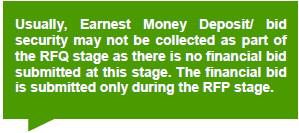
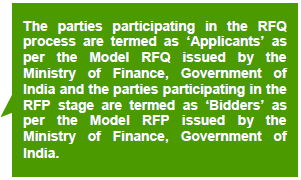
The rationale for short-listing firms is that only those firms that are capable to undertake the project are considered for evaluation in the procurement process. It also rests on the fact that if this is not done, a large number of firms are likely to be selected and firms with lower capability, in their competition with established firms, are likely to undercut and offer irrationally low financial bids compared to their better qualified counterparts. This could affect the quality of service that may eventually come to be offered, since an enterprise with lower capacity might have been selected due to its irrationally low bid submission. As per the overview of the framework given for Model RFQ document issued by Ministry of Finance, Government of India, it is an international best practice to short-list about three to four bidders for the final stage of procurement process. Considering this factor and also recognising that, restricting the list of shortlisted bidder to the best available bidders improves the chances of successful PPP operation, a short-listing of about six to seven pre-qualified bidders has been specified in the Model RFQ to secure high quality and competitive financial bids.
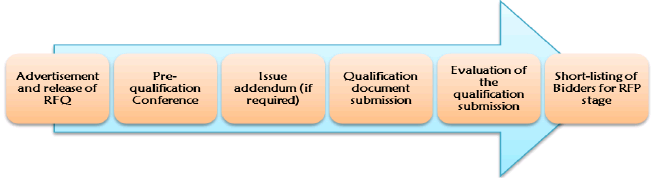
The various steps followed in the RFQ process are given below: