5. Request for Proposal
The purpose of the RFP process is to obtain financial offers from the bidders pre-qualified at the RFQ stage. As part of the RFP document, the procuring Authority needs to provide the feasibility report and draft agreement to all pre-qualified bidders.
The feasibility report is generally provided as a preliminary reference and its contents are not binding on the project Authority. The bidders, while submitting their financial bid, are expected to conduct their own due diligence. The feasibility report generally provides information about the market and technical features of the project, soil investigation or geotechnical report (if applicable), revenue source etc. The draft agreement must document the risk allocated between the parties and the duration of the agreement. Unlike the terms provided in the Project Information Memorandum (PIM), the terms in the draft agreement are binding on the procuring Authority and have an overriding effect over anything to the contrary contained in the RFP.
If a single stage procurement process is adopted by the public entity, it would issue only RFP to interested entities to submit their bids. In such cases, the procurement process would involve multiple stages of evaluations comprising qualification submissions evaluation (of technical and financial capacities), technical proposal evaluation (optional) and financial bid evaluation. At each stage, bidders are shortlisted for evaluation in the next stage. More on the technical proposal stage is set out later in this module. In the case of a two stage procurement process, the RFP involves only the financial bid evaluation with or without the technical proposal evaluation. In this case, the qualification submissions evaluation of technical and financial capacities of the bidder would have been completed in the RFQ stage.
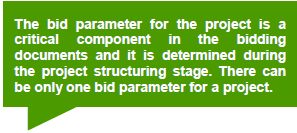
The financial bids for PPP projects in the RFP stage should normally be invited by way of a single objective bidding parameter. The bid parameter is ideally an outcome of the project structuring exercise. The risk sharing among the parties to the arrangement determining the mode of PPP also provides the public entity with the most optimum choice of the bidding parameter. Depending on the project structure which is finally determined for project development, the public entity may consider the following criteria in its selection process:
1. Lowest present value of financial support requested by the bidder - in projects that involve the development of infrastructure projects under PPP framework for all sectors that are identified under the Financial Support for PPPs in Infrastructure scheme.
2. Lowest quantum of land required to complete the project
3. Lowest present value of asset-based support from the Government
4. Highest share (or present value of) of revenue - in projects that involve the development of tourism properties/ hotel properties/ convention centres, etc.
5. Lowest unit value or present value of payments by Government - lowest unit value offered by the bidder or the lowest discount sought by the bidder as a bid parameter, is used in the development of renewable energy projects where the bidder is expected to quote the lowest power purchase tariff/ discount the bidder sought from the public entity.
6. Highest upfront payment (or present value of upfront payment) offered by the bidder - in projects that involve the development of tourism properties/hotel properties, etc.
7. Highest present value of future payment offered by the bidder
8. Lowest agreement period
9. Lowest unit value or present value of user fees
10. Highest premium on (or present value of) equity shares offered
11. Lowest annuity payment sought from the Government - in projects that are financially not viable, often seen in water supply projects, development of roads, etc.
12. Highest periodical payment offered by the bidder - in projects like the development of commercial property/ markets, tourism properties, etc.
13. Highest revenue share - in projects that involve the development of container terminals/ berths in ports.
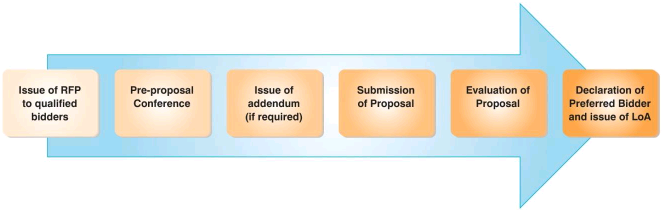
| The various steps followed in the RFP process are given below. The steps to be followed in this regard are similar to the RFQ process. After the evaluation of the financial proposal submitted as part of the bid under the RFP stage, the public entity declares the preferred bidder (the bidder who quotes the best bid) to whom the letter of award/letter of acceptance (LoA) is issued, inviting the bidder to execute the agreement. |
|
| Frequently asked Questions on Procurement Process 1. Whether the qualification criteria set out for the selection of the private partner is suitable for the project? 2. The qualification criteria must be stringent enough to ensure that only capable parties bid but at the same time should not restrict the competition in the procurement process. 3. Whether the methodology for evaluation set out in the bid process is suitable for the project? 4. The evaluation methodology must be in line with the project requirements. If the procurement process is for the selection of a developer then a least cost method of evaluation would be suitable whereas in the case of selection of a consultant, a quality and cost based selection process would be suitable. The evaluation method would change with the project requirements. 5. What would be the amount of bid security? What is its purpose and what if the bid submission is not accompanied by bid security? 6. The amount collected as bid security would usually be for an amount which is equal to 1per cent of the estimated project cost. Bid security is also termed as earnest money deposit and it is collected to ensure that a bidder whose bid is accepted would be willing to enter into a formal contract with the public entity as failure to do so would result in forfeiture of the bid security. Bids that are not accompanied by bid security are rejected. 7. Whether late bids can be accepted? 8. Late bids are usually not entertained by the tender accepting Authority. 9. Whether sealing and marking of bids are important? 10. Sealing and marking of bids are important instructions pertaining to submission of bids that are listed out in the bidding documents. The bidders must at all times ensure that their bids are signed, sealed and marked as required as per the bidding documents. They may also be required to submit their bids in duplicate if required. |