5.3. Qualification Criteria
| The qualification criteria for the short-listing of bidders to the next stage viz. the RFP stage, generally refer to the technical and financial capacity of the bidder to implement the project. RFQ prescribes the minimum capacity/threshold capacity to be met by each bidder. Only those bidders who meet the threshold capacity will then be ranked for being shortlisted for the next stage. |
|
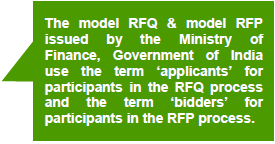
While stringent qualification criteria ensure that only applicants well suited for the RFP stage are pre-qualified, they may also reduce the number of qualified bidders. Therefore, a balance needs to be maintained to achieve the objective of pre-qualifying a reasonable number of bidders for the RFP stage. The principles for determining the qualification criteria should be formulated keeping these considerations in view.
Technical capacity refers to the past experience of the applicant in the project specific sector and core infrastructure sectors (refers to all other infrastructure sectors other than the project specific sector).
Generally, in infrastructure projects, technical capacity is measured in terms of the development and construction experience of the bidder in both the specific sector and core sectors in a defined period. In a complex project even the experience of the bidder in the operation and maintenance of the sector specific project could also be considered.
The technical capacity to be met by the applicant should be fixed considering the complexity and size of the project for which the bids are invited. In setting the criteria, the public entity needs to follow the principle of fairness to ensure healthy competition.
| Tender Process Should be Fair and not Arbitrary M/s. Monarch Infrastructure (P) Ltd. Vs. Commissioner, Ulhasnagar Municipal Corporation &Ors. [AIR2000SC2272] Ulhasnagar Municipal Corporation (UMC) issued a notice inviting tenders for the appointment of agents for collection of octroi. UMC received five bids for the project. After receipt of all the bids and on expiry of the last date for acceptance of the bid, the Commissioner, UMC, took a decision to delete two of the qualification conditions provided in the Bidding Document. This resulted in the selection of one M/s. Monarch Infrastructure (P) Ltd which was otherwise not qualified to be selected because it had failed to meet the conditions that were later removed. The act of UMC was challenged by M/s. Konark Infrastructure (P) Ltd, one of the bidders for the project. The High Court in this case took the view that, "if a term of the tender has been deleted after the players have entered into the arena, it is like changing the rules of the game after it has began". The Supreme Court, reiterating the principle that the Government cannot arbitrarily choose any person it likes for entering into a relationship and cannot discriminate between persons similarly situated, set aside the award of contract made in favour of M/s. Monarch Infrastructure (P) Ltd. by UMC. |
The financial strength of the applicant is checked to examine its financial capacity to implement the project. As such, the financial strength of the selected bidder should be commensurate with the size of the project. Therefore the financial capacity to be met by the applicant shall be fixed taking into account the amount of investment required to be made by the private developer in the project.
The financial capacity of the applicant can be measured in terms of the net worth which is considered as the comprehensive indication of the financial strength. If required, the minimum annual turnover and/or net cash accruals can also be sought by the public entity to measure the applicant's cash flow and financial health.
| How is the Associate's Experience Considered for Evaluation? In calculating the eligibility criteria, the experience and financial capacity of the applicant/consortium member‟s Associate is also considered. The Associate means a person who controls, is controlled by, or is under the common control with such applicant/consortium member. The expression "control" means, with respect to a person which is a company or corporation, the ownership, directly or indirectly, of more than 50percent of the voting shares of such person, and with respect to a person which is not a company or corporation, the power to direct the management and policies of such person by operation of law. |