5.4. Dispute Resolution/ Management
As in any contractual arrangement, differences of opinion may arise between the public entity and the private partner in PPP arrangements. It is in the interests of the project that the parties ensure that such disagreements are managed and resolved without affecting the progress of the project.
Dispute management in PPPs refers to the mechanism for the amicable management of disputes that can arise during the agreement period. The focus in dispute management is not on the resolution of disputes but on creating an environment that reduces their occurrence. Dispute management thrives on a cordial relationship between the public partner and the private entity. It also requires the presence of open communication channels and a periodic assessment of the relationships between the parties.
| While drafting agreements, it is important to refer to the proposed means of resolving disputes because, given that conflict is common, having an effective dispute resolution mechanism in place, encourages investors by giving them confidence that should problems occur there are ways to resolve them. At the detailed level, agreements should always include both formal and informal approaches to dispute resolution. Clear and fair processes to resolve disputes to attract investors are not the only objective. They allow many disputes to be resolved earlier, saving time and money for both parties. Long and acrimonious disputes also generate bad publicity and deter investment. |
|
Disputes should typically be resolved by the contracting parties and attempts should be made to reach an amicable solution outside the judicial system. Invoking the law to resolve disputes increases the cost and risk to both parties to contract and at the same time takes away control of the outcome as the legal decisions are binding on both parties. Public entities should use informal methods to resolve disputes and ensure that regular communication is in place. It is useful to adopt certain benchmarks in dispute management. It may be useful to resolve disputes through informal means such as meetings when the disagreement does not require any amendment to the project agreement. Differences involving amendments to the project agreement may be escalated to arbitration.
MCA for development of National Highways has set out a detailed description of the procedure for arbitration as means of dispute resolution. One way of preventing disputes even arising is through efficient information sharing to see how and why disputes have risen in other PPP projects. This will enable the public entity to look at course correction whenever an issue arises. Sharing information and keep communication open also ensures that issues are resolved as soon as they arise. Issue management is, in fact, a critical element in minimizing disputes. Conflict can be kept to a minimum by maintaining a 'register' of issues which is updated regularly, clear documentation, and strict adherence to escalation procedures.
The guidelines document on post award contract management issued by the Department of Economic Affairs, Government of India sets out a checklist for dispute resolution.
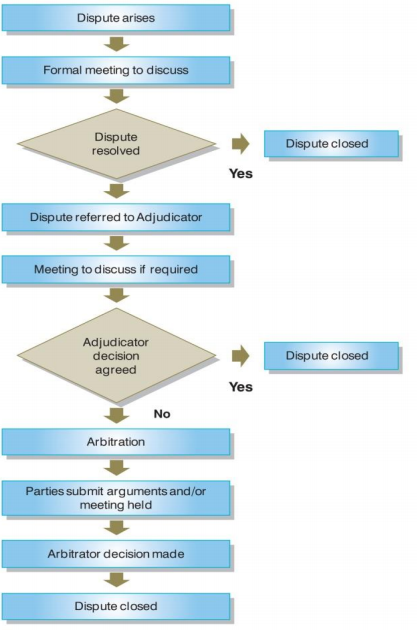
The diagram given below sets out the process that can be adopted in the management of disputes:
The techniques for dispute resolution can either be as simple as one to one negotiation between the parties to the agreement or more complex, formal procedures.
a. Negotiation is the most commonly used form of dispute resolution where the parties come together to discuss a mutually agreeable settlement.
b. Expert determination is useful when it is a technical issue. In a typical expert determination, the parties would agree to be bound by the expert's decision.
c. Mediation involves negotiations with the support of an independent third party. It has the benefit of balanced inputs from a neutral third party.
d. Neutral evaluation is used when the dispute cannot be resolved and the law is likely to be invoked. A test of the merit of such a case can be gauged by a neutral third party with the necessary legal expertise.
e. Arbitration procedures are outlined in the contract. They involve the process for resolving disputes in which both sides agree to be bound by the decision of a third party, the arbitrator. The decision of the arbitrator is binding on the contracting parties.
f. Litigation in court is often a lengthy and costly process.
The features of some typical forms of dispute resolution are set out in the table below:
| Form | Time | Cost | Binding | Adversarial | Special features |
| Negotiation | Varies | Low | No | No | Can continue throughout dispute resolution process |
| Expert Determination | Quite fast | Moderate | Not unless agreed to | Yes | Normally follows directly after negotiations |
| Mediation | Fast | Low | Not unless agreed to | No | - |
| Conciliation | Fast | Low | Not unless agreed to | No | Often within the scope of mediation |
| Arbitration | Fairly slow | Fairly high | Yes | Yes | - |
| Litigation | Slow | High | Yes | Yes | - |
Source: Adapted from Dispute Resolution Guidance of the Office of Government Commerce, U.K.
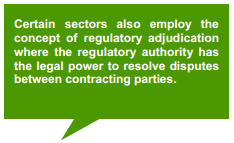
| Regulatory Adjudication in Sectors • Regulatory adjudication involves the use of legal powers by a regulatory Authority to amicably resolve disputes which are brought before it in its sector of operations • Regulatory adjudication is commonly used in the telecom sector in a number of countries • Regulatory agencies have the flexibility of holding formal court-like proceedings or a more informal approach through fact finding based on the specific circumstances of the dispute • In certain countries and for specific disputes, judicial adjudication is used to validate the regulatory decision making process. • Some countries also require Government adjudication subsequent to regulatory adjudication. This may cause a conflict of interest if the Government has a stake in the disputing party. |
Disputes are likely to arise when specific issues are not effectively handled as and when they arise. In such cases, both parties incur huge costs in resolving disputes. To prevent this, all measures to prevent disputes should be taken. If, however, a dispute is unavoidable, then effective dispute resolution measures should be adopted. Recourse to legal adjudication should be made only under exceptional circumstances.
Despite all these methods, some disputes may not be amenable to resolution and may lead to a termination of the agreement before expiry or before the completion of agreement period. Annexure 15 of this Module sets out the 'Procedure for Termination'.