3.1. Roles and responsibilities of each stakeholder
The figure below depicts the importance of the role played by each stakeholder and the capacity requirements for every aspect of the project implementation:
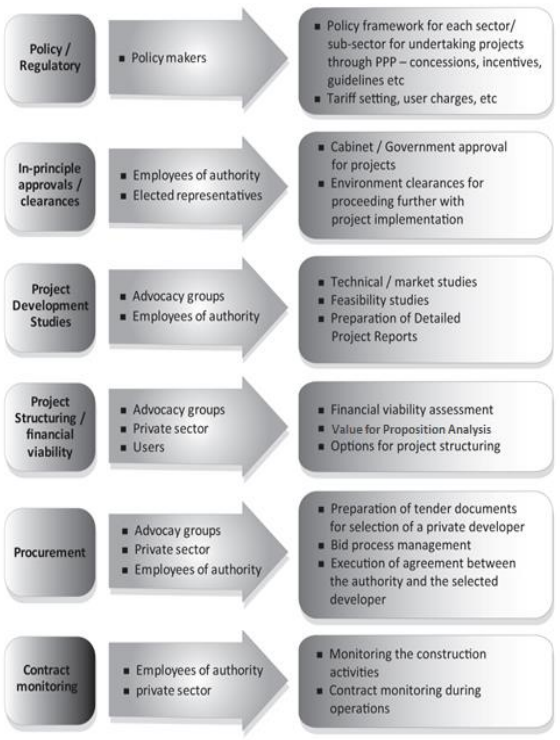
The roles and responsibilities and the capacity requirements of major stakeholder segments is set out herein below.
1. Practitioners: At the project level, it is important for officials of the public entity to be aware of PPP concepts and practices, the project development process, and the project structure. The private partner should also be aware of what is required for PPPs to be successful so that all the stakeholders in a project think along the same lines. This will help everyone develop the project in a smooth and hassle free manner.
2. Policy Makers: Policy making is typically the responsibility of senior officials of the Ministry of Finance, various other line Ministries, Nit Ayog, key PPP agencies and other implementing agencies. Governments also interact with external organisations such as research institutions, development agencies and multilateral/bilateral agencies while formulating policies for various sectors. When policies are well conceived, they can contribute significantly to smooth implementation of a PPP project. The process of formulating policies usually involves demonstrating the Government's commitment to them, spreading awareness of PPP concepts and their applicability across sectors, concessions, incentives provided under schemes if applicable, setting of tariff structures and supporting line Ministries as they develop and implement PPP programmes etc. all of which makes it essential that officials engaged in policy making should possess the necessary skills.
3. Elected representatives: The regional elected leaders and administrators are the drivers of any projects undertaken in a given region as they are responsible for finally providing all the approvals and clearances required for implementing projects. Hence, in order to ensure a local support for implementation of any PPP project which impacts all the stakeholders throughout the project lifecycle, it is important to bring on board the local representatives elected by the communities themselves. It has been seen in past several cases, that commitment from such representatives has been the reason for success of several PPP projects.
4. Consumers: The users who are the most important group among the stakeholders would need to be taken into confidence before initiation of any PPP project implementation. Being the end users to the public services, the response of the users would decide the success or failure of any PPP project. Advocacy groups include the transaction advisors and consultants who play the key role of project identification, feasibility assessment, structuring, procurement, monitoring etc. and hence would assist the Government Authorities with their inherent capabilities. PAP community forms an important sect of the project beneficiaries, hence their understanding of the benefits of the projects and acceptance for rehabilitation cannot be ignored during the project development activities.