A. THE CONCEPTUAL FRAMEWORK
The WDR 2012 framework proposes that households, markets and institutions, and the relations between them, influence gender equality and economic development (refer to Box 1), emphasizing:
"When [the relationships between the household, markets and institutions] are not considered, the intended policy interventions can be muted or contrary to expectations.
The World Bank Group's 2016-2023 Gender Strategy (World Bank Group Gender Strategy),9 built on this framework, aims to tackle four objectives important to promoting gender equality and overcoming the existing gaps in opportunity between men and women (refer to Figure 1):
1. Improving human endowment gaps-reduce health, education and social-protection gaps between men and women.
2. Removing constraints for more and better jobs-increase women's participation in the labor force, enhance income-earning opportunities, and improve access to key productive assets.
3. Removing barriers to women's ownership and control of assets-improve women's access to land, housing and technology.
4. Enhancing women's voice and agency and engaging men and boys-include women in decision making on service delivery; reduce gender-based violence and its impact in conflict situations.
Figure 1: Conceptual Framework for Viewing Gender Equality and Development
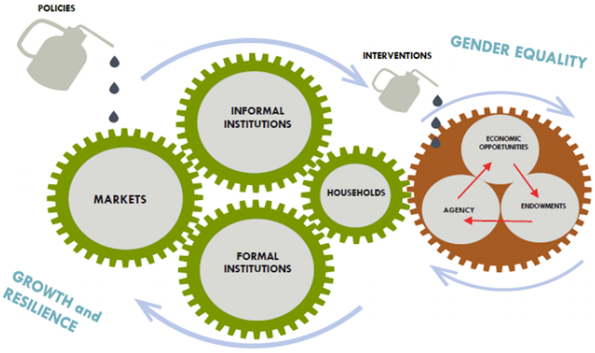
Source: World Bank Group gender strategy (FY16-23): gender equality, poverty reduction and inclusive growth (English), World Bank, 2015
____________________________________________________________________________
9 World Bank Group gender strategy (FY16-23): gender equality, poverty reduction and inclusive growth (English), World Bank, 2015. http://documents.worldbank.org/curated/en/820851467992505410/World-Bank-Group-gender-strategy-FY16-23-gender-equality-poverty-reduction-and-inclusive-growth.