Institutional setup for PPPs
Typically, a key element in a PPP institutional setup is a unit that facilitates the implementation of national PPP programs. These units have a number of roles that can include promoting PPPs to investors, guiding PPP policies and plans, offering technical support to projects, overseeing project implementation, and approving projects or advising on the approval process.
Exhibit 8
PPP units vary by the needs and capacity of the government
| PPP unit | Policy guidance | Investment promotion | Technical support | Capacity building | Projects approval |
U.K. | Infrastructure and Projects Authority |
|
|
|
|
|
Victoria state, Australia | Partnerships Victoria |
|
|
|
|
|
South Africa | National Treasury's PPP unit |
|
|
|
|
|
South Korea | PIMA C |
|
|
|
|
|
France | French PPP Think Tank |
|
|
|
|
|
Greece | Special Secretariat for PPPs |
|
|
|
|
|
Italy | Unità tecnica Finanza di Progetto (UTFP) |
|
|
|
|
|
Germany | PPP Task Force |
|
|
|
|
|
Turkey | International PPP Platform |
|
|
|
|
|

Source: PPP Knowledge Lab; government websites; Ian Hawkesworth, "Dedicated PPP Units," 2009 (https://www.oecd.org/gov/budgeting/42344329.pdf); "Dedicated Public-Private Partnership Units: A Survey of Institutional and Governance Structures," OECD, 2010 (http://www.keepeek.com/Digital-Asset-Management/oecd/governance/dedicated-public-private-partnership-units_9789264064843-en#page36); Strategy& analysis
The roles assumed by a PPP unit depend on several factors: the objectives of the PPP program and the functions required to achieve them, the existing capacity within government to manage the program, and existing weaknesses or failures within government that the PPP unit must fll. Moreover, the roles of a PPP unit can change over time, when, for instance, the capacity of the line ministries to manage PPP projects becomes more sophisticated. In such a case, the responsibility for administering PPPs might be redirected to their respective ministries, and the PPP unit's role could be shifted to establishing best practices and setting guidelines (see Exhibit 8).
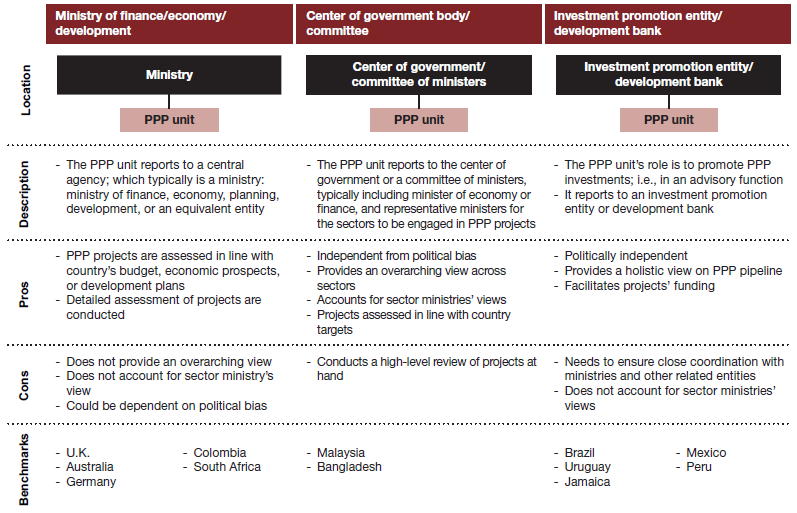
The governance model for a PPP unit and its location within government also take various forms depending on the unit's roles, and the existing institutional roles and experience within the government. In some countries, the PPP unit is subordinate to a central body such as a ministry. In other cases, the PPP unit is under the wing of the center of the government (i.e., the prime minister or cabinet) or a committee composed of ministers. A third option is to have an advisory unit that is beneath a development bank or investment promotion body (see Exhibit 9).
Exhibit 9
A PPP unit's governance model can take several forms depending on its role and the scope of its work
The key success factors for PPP units include political commitment, coordination of roles and responsibilities, location within a powerful agency, and a high-caliber talent pool with technical expertise. PPP units should focus on adding value via the promotion and structuring of projects, rather than only becoming an additional level of approvals. Furthermore, studies show that locating a PPP unit within an influential and politically connected agency can be a critical determinant of success.6