1.2.2 PPP as a Tool for Greater Efficiency
The efficient use of scarce public resources is a critical challenge for governments-and one in which many governments fall far short of goals. The reason is that the public sector typically has few or no incentives for efficiency structured into its organization and processes and is thus poorly positioned to efficiently build and operate infrastructure. Injecting such incentives into an entrenched public sector is difficult, though not impossible, as Singapore has demonstrated by developing a government-wide dedication to efficiency while maintaining many critical services within the public domain.
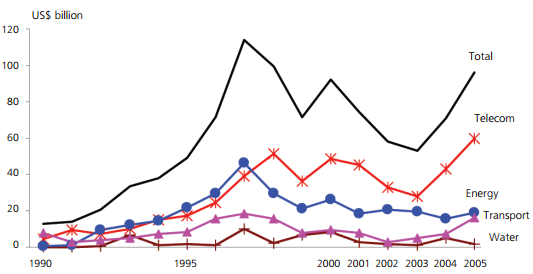
In 2005, investment commitments to private infrastructure projects in low- and middle-income countries grew by over 30% against 200 to almost $96 billion. Figure 1: Investment Commitments in Infrastructure Projects with Private Participation in Developing Countries by Sector, 1990-2005
The World Bank estimates that about 70% of infrastructure investment currently comes from the public sector, 8% from official development assistance, and 22% from the private sector. Source: http://ppi.worldbank.org/features/sept2006/currentFeatureSept2006.pdf |
Private sector operators, however, enter into an investment or contracting opportunity with the clear goal of maximizing profits, which are generated, in large part, by increased efficiency in investment and operations. If the PPP is structured to let the operator pursue this goal, the efficiency of the infrastructure services will likely be enhanced. Improving the efficiency of services and operations also increases the chances that those services are economically sustainable and provided at affordable rates-even after satisfying the profit requirements of the private operators.
PPP allows the government to pass operational roles to efficient private sector operators while retaining and improving focus on core public sector responsibilities, such as regulation and supervision. Properly implemented, this approach should result in a lower aggregate cash outlay for the government, and better and cheaper service to the consumer. This should hold true even if the government continues to bear part of the investment or operational cost since government's cost obligation is likely to be targeted, limited, and structured within a rational overall financing strategy.