3.6 Stakeholder Consultation
Despite the long experience with PPPs, they remain controversial among a range of stake-holders. This is partly attributable to the diverse range of stakeholders involved in the process and the difficulty in reconciling their interests and concerns. In addition, too often the stakeholders have not been properly consulted or engaged in the process. Consultation is increasingly seen as important for several reasons:
• Inadequate consultation or communication with stakeholders increases the danger of opposition, potentially late in the process, leading to delays or even cancellation
• Furthermore, the stakeholders are critical to the sustainability of a PPP. Even if the contract is awarded despite opposition, the difficulty and risk of the project increase drastically if public support is not present.
• Stakeholders provide valuable input to the design and practicality of an approach. Allowing stakeholders to comment on PPP strategies allows for a sense of buy-in and can lead to innovative approaches.
• Broad public support and understanding of the reform agenda encourage politicians to stay committed.
• Dissemination of information leads to increased credibility of project partners.
Despite these compelling reasons, some governments see risk in public consultation either through the danger of raising expectations that may not be met, through losing control of the flow of information, through the danger of being unable to reconcile differences, or because information might fuel opposition. These risks are easily outweighed by the benefits of communication and the crucial role it plays in building support for, and understanding of, PPP.
Each role is critical, yet specific stakeholders will have different interests that influence how they approach their role. There must be a consultation process to reconcile and prioritize issues, leading to broad agreement on the objectives of PPP. Table 2 lists the roles of the PPP process stakeholders and Figure 3 illustrates their interests.
| Table 2: Role of Different Stakeholders in the PPP Process | |
| Stakeholder Political decision makers | Role Establish and prioritize goals and objectives of PPP and communicate these to the public |
| Approve decision criteria for selecting preferred PPP option | |
| Approve recommended PPP option | |
| Approve regulatory and legal frameworks | |
| Company management and staff | Identify company-specific needs and goals of PPP Provide company-specific data Assist in marketing and due diligence process |
|
| Implement change |
| Consumers | Communicate ability and willingness to pay for service Express priorities for quality and level of service Identify existing strengths and weaknesses in service |
| Investors | Provide feedback on attractiveness of various PPP options Follow rules and procedures of competitive bidding process Perform thorough due diligence resulting in competitive and realistic bidding |
| Strategic consultants | Provide unbiased evaluation of options for PPP Review existing framework and propose reforms Act as facilitator for cooperation among stakeholders |
| Source: Heather Skilling and Kathleen Booth. 2007. | |
Figure 3: The Range of Stakeholder Interests in PPPs
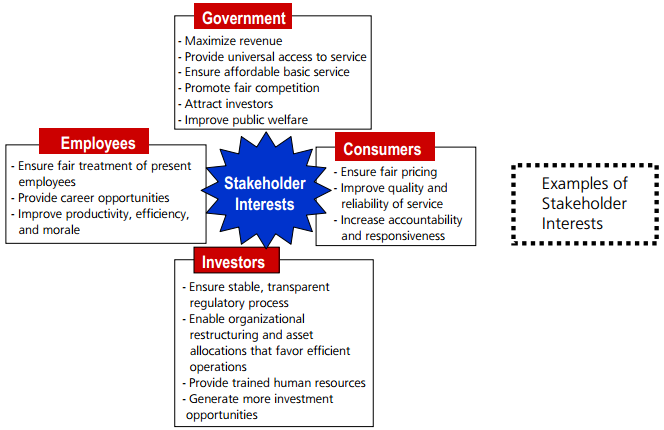
Source: Heather Skilling and Kathleen Booth. 2007.
For stakeholders to play an active role in the PPP process, they must be given not only a forum for participation but also the information they need to participate effectively.
The appropriate forum to communicate and build support for PPP is through an iterative dialogue with stakeholders. Each communications program must be tailored to the local context and PPP, but would include some or all the components below:
• Opinion research: Opinion research gathers data on stakeholders, their perceptions, and behaviors with respect to the issues concerning a specific PPP. The research influences the content and media of the communications program as well as the reforms themselves. The research is conducted on a relatively formal basis through questionnaires, polling, etc.
• Stakeholder consultation: Consultation is a less formal process through which themes and policies of interest are discussed within or across stakeholder groups. It is intended to gather information and build an understanding among the reformers as to current perceptions and understanding and the basis of those opinions. A key part of stakeholder consultation is to manage expectations with respect to how feedback will be incorporated into the reform process; that is, the feedback may not translate into direct change in the PPP design or process but will be one stream of influence. This might be accomplished through focus groups or stakeholder discussion groups.
• Public awareness: Public awareness efforts are aimed at a broad range of stakeholders and designed to increase general awareness of an issue. This is a proactive distribution of information that will help inform public reaction to PPP. This might be done through TV, radio, town meetings, and newspapers. See Box 2 as an example.
• Public education: Public education is the process of providing stakeholders with the tools and information required to increase understanding of an issue or to take on a new role. This is a more specific and detailed program than public awareness.
Communication activities have to begin early in the process and continue through to closure and even during implementation. The project structure should incorporate mechanisms to ensure ongoing communication with the public and customers.
The communication program associated with PPP has to occur not only at all stages of PPP, but on several levels: at the policy or key decision-makers' level, the level of the enterprise, among the stakeholders specifically affected by a PPP, and among the public at large as needed.
| Box 2: Promoting Transparency-The Case of Manila Water (Philippines) |
| To build support for introducing Private Participation in Infrastructure (PPI) in water and wastewater services in Metro Manila, the Government of the Philippines embarked on a comprehensive strategic communications program that included among its objectives the promotion of transparency in the PPI transaction. To educate the public on the measures being taken to ensure transparent procurement, the Government launched a media campaign months before the bidding process to explain the process and the precautions being taken. Because public procurements in the Philippines are commonly subject to protests, congressional inquiries, and graft investigations, the media campaign focused strongly on the elaborate security measures used to protect the integrity of the bids. In addition, it highlighted the objective nature of the evaluation process, which did not award points for the quality of the technical approach. To ensure that media was informed about the bid process, the Government also prepared a video presentation regarding the rules for bidding and the procedure for opening bids, which was open to the public. The high-profile communications and public relations efforts of the Government resulted in strong media coverage of the bid process. It did not produce the controversy or opposition experienced during prior public procurements. The Philippine Government attributes the project's success largely to the design of a transparent procurement process and to the perception among stakeholders (developed because of the media campaign) that the process was transparent. |
| Source: Dumol, Mark. 2000. The Manila Water Concession: A Key Government Official's Diary of the World's Largest Water Privatization. Washington, DC: World Bank. |