4 Structuring a PPP: Available PPP Options
This chapter discusses the main PPP options available for consideration. Each presents different characteristics to be assessed against the sector reform objectives. The basic PPP contract types are:
• service contracts;
• management contracts;
• affermage or lease contracts;
• build-operate-transfer (BOT) and similar arrangements;
• concessions; and
• joint ventures.
As can be seen in Figure 4, all forms are currently in place in Asia.
Figure 4: Reported Operations Public-Private Partnerships in Asia by
Contract Type, Including (4.1) and Excluding (4.2) Service Contract
| Figure 4.1
| Figure 4.2
|
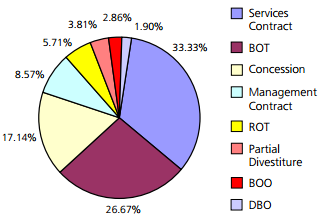
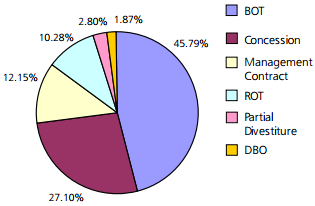
BOO = build-operate-own, BOT = built-operate-transfer, DBO = design-build-operate, ROT= rehabilitate-operate-transfer.
Source: Weitz, Almud, and Richard Franceys, editors. 2002. Beyond Boundaries, Extending Services to the Urban Poor. Manila: ADB.
Each PPP option implies varying levels of responsibility and risk to be assumed by the private operator, together with differences in structures and contract forms as discussed in the sub-sequent sections and summarized in Table 3. Increasingly, contracts are becoming hybrids, adopting features of several contracts to reflect the best local requirements.
Table 3: Summary of Key Features of the Basic Forms of Public-Private Partnership (PPP)
|
| SERVICE CONTRACTS | MANAGEMENT | LEASE CONTRACTS | CONCESSIONS | |
| Scope | Multiple contracts for a variety of support services such as meter reading, billing, etc. | Management of entire operation or a major component | Responsibility for management, operations, and specific renewals | Responsibility for all operations and for financing and execution of specific investments | Investment in and operation of a specific major component, such as a treatment plant |
| Asset Ownership | Public | Public | Public | Public/Private | Public/Private |
| Duration | 1-3 years | 2-5 years | 10-15 years | 25-30 years | Varies |
| O&M Responsibility | Public | Private | Private | Private | Private |
| Capital Investment | Public | Public | Public | Private | Private |
| Commercial Risk | Public | Public | Shared | Private | Private |
| Overall Level of Risk Assumed by Private Sector | Minimal | Minimal/moderate | Moderate | High | High |
| Compensation Terms | Unit prices | Fixed fee, preferably with performance incentives | Portion of tariff revenues | All or part of tariff revenues | Mostly fixed, part variable related to production parameters |
| Competition | Intense and ongoing | One time only; contracts not usually renewed | Initial contract only; sub-sequent contracts usually negotiated | Initial contract only; sub-sequent contracts usually negotiated | One time only; often negotiated without direct competition |
| Special Features | Useful as part of strategy for improving efficiency of public company; Promotes local private sector development | Interim solution during preparation for more intense private participation | Improves operational and commercial efficiency; Develops local staff | Improves operational and commercial efficiency; Mobilizes investment finance; Develops local staff | Mobilizes investment finance; Develops local staff |
| Problems and Challenges | Requires ability to administer multiple contracts and strong enforcement of contract laws | Management may not have adequate control over key elements, such as budgetary resources, staff policy, etc. | Potential conflicts between public body which is responsible for investments and the private operator | How to compensate investments and ensure good maintenance during last 5-10 years of contract | Does not necessarily improve efficiency of ongoing operations; May require guarantees |
| BOT = build-operate-transfer, O&M = operation and maintenance. | |||||
This chapter provides an overview of the key features of each option as well as some inherent advantages and disadvantages. In addition, decision makers should consider carefully the local capacity available to implement options that are more complex. PPPs with complicated financial structures and/or extensive contractual or monitoring requirements will necessitate hiring and/or training staff, a process that has to be accomplished in advance of the need.
Finally, it should be noted that different PPP forms are more readily adapted to particular sectors or project types and have been used more extensively in these contexts. As part of the selection process outlined in chapter 5, decision makers should note the prior depth of experience in using a particular type of PPP in a particular sector.