4.2 Management Contracts
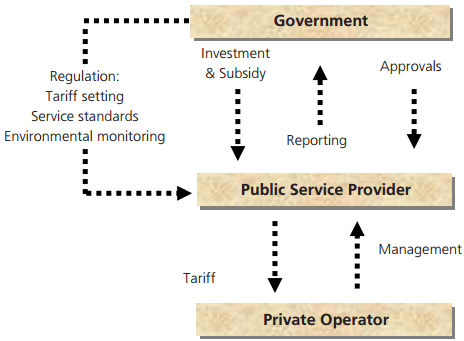
A management contract expands the services to be contracted out to include some or all of the management and operation of the public service (i.e., utility, hospital, port authority, etc.). Although ultimate obligation for service provision remains in the public sector, daily management control and authority is assigned to the private partner or contractor. In most cases, the private partner provides working capital but no financing for investment. Figure 5 illustrates the typical structure of a management contract.
Figure 5: Structure of Management Contract
Source: Heather Skilling and Kathleen Booth. 2007.
The private contractor is paid a predetermined rate for labor and other anticipated operating costs. To provide an incentive for performance improvement, the contractor is paid an additional amount for achieving prespecified targets. Alternatively, the management contractor can be paid a share of profits. The public sector retains the obligation for major capital investment, particularly those related to expand or substantially improve the system. The contract can specify discrete activities to be funded by the private sector. The private partner interacts with the customers, and the public sector is responsible for setting tariffs. A management contract typically, however, will upgrade the financial and management systems of a company and decisions concerning service levels and priorities may be made on a more commercial basis. Box 4 describes Cambodia's experience with management contracts in the primary health care sector.
| Box 4: Cambodia-Contracting Out Primary Health Care to Nongovernment Organizations |
| In addition to their uses in infrastructure, management contracts are used for other municipal services such as health care. In Cambodia, 4-year management contracts with nongovernment organizations were put in place in primary health care facilities in 12 districts. The contractor has full-line management responsibility and must respond to performance targets including achievements in immunization, antenatal care, family planning, and services to the poor. The contractor must provide certain services free of charge (emergency obstetrical care, minor surgery, inpatient treatment of serious illnesses). Compared with publicly managed facilities, the Government found that private management was more effective than public management in terms of performance and coverage achievements, and improvement in working conditions for staff. |
| Sources: Loevinsohn, Benjamin. 2000. Contracting for the Delivery of Primary Health Care in Cambodia: Design and Initial Experience of a Large Pilot Test. World Bank Institute Flagship Program Online Journal. Available: www.worldbank.org/wbi/healthflagship/journal/index.htm; Bhushan, Indu, Sheryl Keller, and Brad Schwartz. 2002. Achieving the Twin Objectives of Efficiency and Equity: Contracting Health Services in Cambodia. Economic and Research Department Policy Brief No. 6. Manila: ADB. |