4.4 Concessions
A concession makes the private sector operator (concessionaire) responsible for the full delivery of services in a specified area, including operation, maintenance, collection, management, and construction and rehabilitation of the system. Importantly, the operator is now responsible for all capital investment. Although the private sector operator is responsible for providing the assets, such assets are publicly owned even during the concession period. The public sector is responsible for establishing performance standards and ensuring that the concessionaire meets them. In essence, the public sector's role shifts from being the service provider to regulating the price and quality of service. Table 4 and Box 6 are samples of infrastructure concessions.
The concessionaire collects the tariff directly from the system users. The tariff is typically established by the concession contract, which also includes provisions on how it may be
| Table 4: Examples of Infrastructure Concessions in Developing and Transitional Economies | |
| Telecommunications People's Republic of China (PRC), Cook Islands, Guinea-Bissau, Hungary, Indonesia, Madagascar, Mexico | Electricity PRC, Cote d'Ivoire, Guinea, Hungary, Mexico |
| Natural Gas Transport and Distribution Argentina | Railways Argentina, Brazil, Burkina Faso, Chile, Cote d'Ivoire, Mexico |
| Water Distribution Argentina, Brazil, Chile, PRC, Colombia, Cote d'Ivoire, Guinea, Hungary, Indonesia, Macao, Malaysia, Mexico, Philippines, Senegal | |
| Source: Resides, Ioannis N.. 2004. Reforming Infrastructure: Privatization, Regulation and Competition: A World Bank Policy Research Report. Washington, DC: World Bank. | |
| Box 6: Republic of Korea's First Airport Railway |
| The first railway concession project is underway in the Republic of Korea (ROK). The 61.7 kilometer (km) line from Seoul city center to Incheon International Airport will offer both commuter and express service. The 41-km first phase of a new commuter and express rail air link in ROK opened in 2007 between Incheon International Airport and Gimpo domestic airport. It will be extended by 20.7 km 2.5 years later to take the line into the heart of the capital at Seoul central station. The project is strongly supported by the national and regional governments as a means of linking the Incheon hub to Seoul and the recently opened KTX high-speed railway, which runs from Seoul Central station to Busan. It is the first railway concession project in ROK. Incheon International Airport Railroad Company (Iiarco), a special purpose company incorporated in March 2001, has a 30-year operating concession from the end of construction. Iiarco has 11 shareholders, led by Hyundai Engineering and Construction (HDEC) with 27%, Posco Engineering and Construction (11.9%), Daelim Industrial (10%), Dongbu Corporation (10%), Korea Rail Network Authority (9.9%), and six other Korean companies. Bechtel is providing support for project management to Iiarco and a Korean consultant, Kortech, is also assisting the concessionaire. |
| Source: Knutton, Mike. 2004. International Railway Journal. May. |
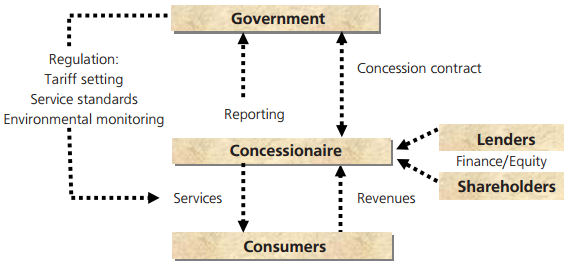
changed over time. In rare cases, the government may choose to provide financing support to help the concessionaire fund its capital expenditures. The concessionaire is responsible for any capital investments required to build, upgrade, or expand the system, and for financing those investments out of its resources and from the tariffs paid by the system users. The concessionaire is also responsible for working capital. A concession contract is typically valid for 25-30 years so that the operator has sufficient time to recover the capital invested and earn an appropriate return over the life of the concession. The public authority may contribute to the capital investment cost if necessary. This can be an investment "subsidy" (viability gap financing) to achieve commercial viability of the concession. Alternatively, the government can be compensated for its contribution by receiving a commensurate part of the tariff collected. A concession contract's typical structure is shown in Figure 7.
Figure 7: Structure of Concession Contract
Source: Heather Skilling and Kathleen Booth. 2007.