4.5 Build-Operate-Transfer and Similar Arrangements
BOT and similar arrangements are a kind of specialized concession in which a private firm or consortium finances and develops a new infrastructure project or a major component according to performance standards set by the government. Figure 8 illustrates the BOT contract structure.
Figure 8: Structure of a Build-Operation-Transfer (BOT) Contract
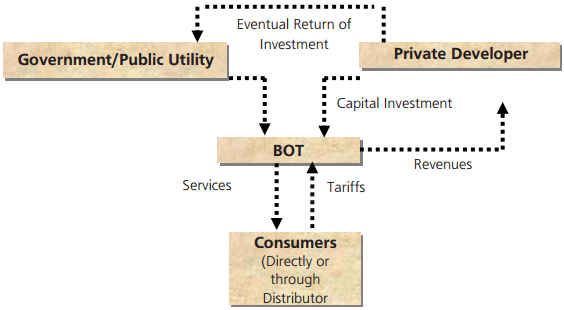
Source: Heather Skilling and Kathleen Booth. 2007.
| Table 5: Basic Project Delivery Options | ||||||
| Own | Conceive | Design | Build | Operation & Maintenance | Financial Responsibility | |
| Design-Bid-Build | Public | Public | Private by fee contract | Public | Public | |
| Design-Build | Public | Public | Private by fee contract | Public | Public | |
| Build-Operate- Transfer (BOT) | Public | Public | Private by fee contract | Public | ||
| Design-Build- Finance-Operate (DBFO) | Public | Public or Private | Private by fee contract | Public, Public/Private, or Private | ||
| Build-Own- Operate (BOO) | Private | Public or Private | Private by contract (concession) | |||
| Source: United States Department of Transportation, Federal Highway Administration. Available: www.fhwa.dot.gov/ppp/options.htm | ||||||
The variations of BOT-type contracts include those cited in Table 5. Several of these are discussed in this section.
Under BOTs, the private partner provides the capital required to build the new facility. Importantly, the private operator now owns the assets for a period set by contract-sufficient to allow the developer time to recover investment costs through user charges.
The public sector agrees to purchase a minimum level of output produced by the facility, sufficient to allow the operator to recover its costs during operation. A difficulty emerges if the public sector has overestimated demand and finds itself purchasing output under such an agreement ("take-or-pay") when the demand does not exist. Alternatively, the distribution utility might pay a capacity charge and a consumption charge, thus sharing the demand risk between the public and private partners. BOTs generally require complicated financing packages to achieve the large financing amounts and long repayment periods required. (See Box 7).
At the end of the contract, the public sector assumes ownership but can opt to assume operating responsibility, contract the operation responsibility to the developer, or award a new contract to a new partner.
The distinction between a BOT-type arrangement and a concession-as the term is used here-is that a concession generally involves extensions to and operation of existing systems, whereas a BOT generally involves large "greenfield" investments requiring substantial outside finance, for both equity and debt. However, in practice, a concession contract may include
| Box 7: Build-Operate-Transfer for the Construction and Operation of a Solid Waste Transfer Facility in Hong Kong, China |
| Hong Kong, China issued a build-operate-transfer for constructing and operating its solid waste transfer facilities, which include a transfer station and fleet of transfer trucks. The Government prequalified several firms based on their experience in designing and operating transfer stations, and then held a competitive tendering process to select the winning firm. The bidding documents laid out technical and environmental performance requirements, maintenance requirements, and equipment replacement schedules. The station has been built and is currently in operation. The Government conducts regular inspections of the transfer facilities to verify that the specified requirements are being met. |
| Source: Public-Private Cooperation in the Delivery of Urban Infrastructure Services (Options & Issues). Public-Private Partnerships for Urban Environment Working Paper I. United Nations Development Programme (UNDP). Available: www.undp.org/pppue/gln/publications |
the development of major new components as well as extensions to existing systems, and BOTs sometimes involve expansion of existing facilities.
There are many variations on the basic BOT structure including build-transfer-operate (BTO) where the transfer to the public owner takes place at the conclusion of construction rather than the end of the contract and build-own-operate (BOO) where the developer constructs and operates the facility without transferring ownership to the public sector. Under a design-build-operate (DBO) contract, ownership is never in private hands. Instead, a single contract is let out for design, construction, and operation of the infrastructure project.
The questions of ownership and the timing of the transfer are generally determined by local law and financing conditions, and the number of possible permutations is large. (See Box 8).
With the design-build-finance-operate (DBFO) approach, the responsibilities for designing, building, financing, and operating are bundled together and transferred to private sector partners. DBFO arrangements vary greatly in terms of the degree of financial responsibility that is transferred to the private partner.