6.2 Technical Preparation
The technical specifications of the proposed PPP project need to be defined and documented in the terms of reference, and ultimately enshrined in the PPP contract. The preparation stage is the time to develop the preliminary specifications. Development of the final technical specifications of a project is an iterative process which builds on feedback from the market and the affordability of the project at each design stage.
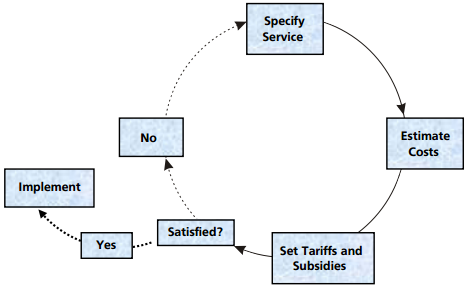
The technical design of a project starts with identification of desired coverage targets and service standards. From these starting points, estimating the cost of these desired services (factoring in presumed efficiency gains) and cost recovery tariffs is possible. Government has the option of putting these cost recovery tariffs in place, subsidizing cost-recovery, or revisiting the initial targets and service standards. Figure 10 illustrates the balancing of service and costs.
Figure 10: Balancing Service and Costs
Source: World Bank and PPIAF. 2006. Approaches to Private Participation in Water: A Toolkit.
The technical preparation builds on (and refines) the analytical work that has been done in preparing the sector analysis and road map, including demand analysis, asset inventory, and investment analysis.
Technical terms of reference need to strike a balance between being too narrow/restrictive and too loose. Technical specifications that are too narrow may mean that a bidder is prohibited from using the most economical technical solution. Too loose terms may lead to proposals that diverge significantly from each other and are hard to compare and rank. A strategy for dealing with this dilemma is to focus on defining the technical outputs expected rather than dictating the inputs to be employed, thus allowing the bidders some reasonable latitude to determine the most efficient way to achieve outputs.
The technical terms of reference enable bidders to understand required outputs, quantify necessary investment, and estimate resulting operating performance.
Below are two samples, Boxes 10 and 11, of the type of specifications that might be contained in the technical portion of a request for proposals:
| Box 10: Example of Performance Specifications in Railway PPPs |
| Performance Specifications - Railway PPPs Key technical specifications to be detailed in a railway PPP might include: Availability of service: • Stations: locations, opening hours, passenger throughout Trains: • Journey time, frequency, passenger capacity System: • reliability, safety, degraded mode operation Ambience - quality of journey: • Quality of finishes, seat/standing ratio, lifts and escalators, customer information, fare collection Capability: • system architecture, external interfaces Transfer: • return conditions, maintenance manuals and records, final years issues |
| Source: Dr. Higton, Nick. Using Public Private Partnership to Deliver Successful Rail Projects. Ove Arup & Partners Ltd. |
| Box 11: Example of Performance Specifications in Water PPPs |
| Performance Specifications - Water Service PPPs Key technical specifications to be detailed in a water and sanitation PPP might include: Coverage Targets: • Number of new direct household connections, or the percentage of households to be connected • Percentage of roads with tertiary pipes • Geographic area to be served through direct connections, kiosks, standpipes, or other nonpiped delivery systems (for water services), and public latrines or other improved sanitation options (for sanitation services). Quality Standards: • Availability of service • Pressure • Water quality • Effluent treatment • Customer service |
| Source: World Bank and PPIAF. 2006. Approaches to Private Participation in Water: A Toolkit. |