| A. Strategic Pillars |
Achieving the Privatization Program's ambitions requires three strategic pillars, which are establishing the legal/regulatory basis, establishing the institutional basis, as well as steering the sector privatization programs.
Our strategy is built on :
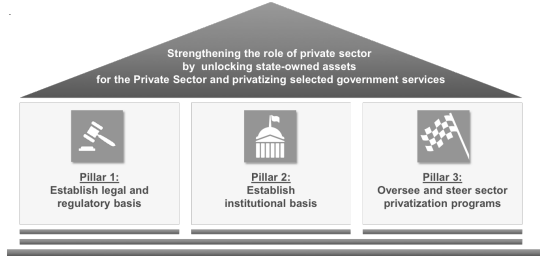
 Pillar 1: Establishing the legal and regulatory basis; this includes:
Development of privatization general legislative frameworks:
The first aspect of this initiative is to enable privatization processes and its governance by setting clear and specific procedures that increase the level of preparation and execution of privatization. This aspect will also set standard and specific procedures for the process of offering privatization projects which will increase the level of operational governance. It also includes rules of building working teams, appointing consultants and communication with the private sector; and thus will help this aspect of solving a part of the main challenges to ensure the achievement of the desired aspirations, and raise the level of transparency and integrity in the privatization process. It is worth mentioning that the Council of Ministers Resolution No. (665) dated 8/11/1438 H gave the Board of Directors of the National Center for Privatization the authority to issue a number of rules, procedures, controls and standards that will form the core of this aspect. As for the second part of this initiative, it includes reviewing the provisions of a number of regulations, legislation and rules that intersect with privatization; and analyze them to identify the gaps and legislative obstacles that may be contained within those regulations, legislations, and rules. Then, propose solutions and work to address those obstacles which will enable the privatization process and ensure that it is attractive to investors, enhances the interests of the government and raises the level of achieving the benefits of privatization. It is worth mentioning that the Council of Ministers has directed to exclude privatization from government competition and procurement system for the above reasons. The Council of Ministers also directed the National Center for Privatization (NCP) to draft a privatization project which includes the necessary exceptions from the relevant regulations.
Develop legislative frameworks that govern the targeted sectors for privatization:
This involves a comprehensive review of the entire regulatory environment in that sector, and then identifying development areas that are compatible with the role of the future government as regulator and the role of the private sector as an operator (including a review of many aspects of the sector such as pricing services, identifying relationships between entities operating in the sector and its structure, and consumer protection and other technical aspects). The decision of the Council of Ministers No. (665) dated 8/11 / 1438 H indicated that every supervisory committee must conduct a comprehensive study that includes the regulatory aspects. NCP will work with the supervisory committees and their execution teams to conduct this comprehensive review and then identify the necessary steps to implement them.
Pillar 2: Establishing the institutional basis that would contribute to create entities that are able to drive the execution of the privatization efforts in a controlled manner while maintaining government benefits, guaranteeing fair contributions of the private sectors, and enhancing the quality of service provided to citizens including:
The structural mechanism development of the "Opportunity Explorer":
-private partnership and asset-A regulatory approach will be developed to explore potential projects in the public he preliminary survey study replaces sale projects. This approach can be designed in such a way as to ensure that t the initial feasibility study and this will save efforts. This approach will also include specific initial steps in edcollaboration with relevant government agencies to help strengthen the base of projects to be discover.
Activation of the Privatization Supervisory Committees and Execution Teams:
As mentioned above, there is a scarcity of experience and skills in privatization. Thus, the activation of the Supervisory Committees will enable them to attract man power and talent to assist them in the process of designing, preparing and executing the privatization process. This is an important element for the success of the privatization he government's interests, the fairness of the process according to the considerations of t, the sustainability of the privatization model, and the achievement of desired benefits to citizens.
Identifying privatization strategies, indicators and incentive mechanisms for privatization:
Following the activation of the Supervisory Committee for the sector, it will work to develop the privatization strategy based on specific targets of relevant sectors, in accordance with the regular procedures. Then, it will work on developing indicators and criteria for privatization, and develop elements in the environment surrounding privatization initiatives to stimulate privatization.
Enable the National Center for Privatization (NCP):
NCP will work on developing or proposing frameworks that will enable and manage privatizations. NCP will also ensure that the designing, preparations and implementation are carried out in accordance with the approved governance frameworks. It will ensure the level of efficiency of the system and ensure maximizing the benefit of the system of expertise in privatization.
Privatization Innovation Center:
The privatization processes are complex and go through a relatively large number of stages and procedures. This ign of the privatization initiative and will have an effect on may result in a loss of focus on the importance of the des e desired benefits to achieveth from the program. The establishment of this center is to ensure that the benefits i the minds of employees are not forgotten. .The Privatization ter develops solutions and initiatives Innovation Cen the benefits of privatization that enhance (e.tion opportunitiesg, raising local content and raising SME participa).
This platform is essential for achieving the program's aspirations and facing the challenges. It is very important to design the program to suit the local environment and address the challenges; therefore, it is designed according to the following considerations:
• There are institutions that focus on stimulating and monitoring privatization.
• The importance of providing a unified view of initiatives in all sectors.
• A decentralized model has been selected as the institutional basis to govern privatization international benchmarks indicate the best options would be somewhere between the centralized model and a more decentralized model. The reason for this is that there is a need for reforms in the targeted sectors for privatization, and it is difficult to obtain data and information on assets and services targeted for privatization. The technical advantage of our model is that the workers are closer to the technical aspects of the entity. And, this model will speed the preparation of privatization in all targeted sectors, and the centralized element will ensure that all processes are organized and managed for transparency, integrity and fulfilment of the necessary requirements by one entity.
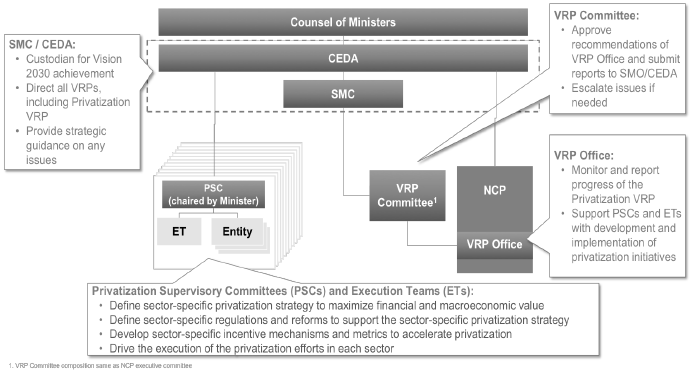
Accordingly, a strong governance model has been designed, in line with the Council of Ministries Resolutions number (665) dated 8/11/1438 H and number (355) dated 7/6/1438 H, as follows:
• Strategic Management Committee (SMC), part of Council for Economic and Development Affairs (CEDA) is responsible along with CEDA for the achievement of Vision 2030. They direct all 12 VRPs, including the Privatization VRP and provide guidance on any strategic decision or issues resolution. The strategic committee also reviews the recommendations of the supervisory committees and ensures their strategic relevance in preparation for submission to the Council for Economic and Developmental Affairs for their economic review, as well as the Council of Ministers for final approval if this is a statutory requirement, whether the privatization project is to sell assets or partnership between public and private sectors. Each Supervisory Committee will propose the appropriate privatization method which should include an analysis of how the project will be offered to the public through public offering. The strategic committee will review the proposed privatization method to ascertain the appropriateness of the public participation model and the public offering.
• The VRP Committee is the direct oversight body of the Privatization VRP. It approves recommendations of the VRP Office and submits reports to SMO / CEDA. It decides whether program-related issues need escalation or not. The program's initiatives are being continuously reviewed and submitted to the Strategic Committee and the Council for Economic and Developmental Affairs.
• The VRP Office is an office in the National Center for Privatization and administratively follows the VRP Committee. The VRP office is responsible to monitor and report progress of the Privatization VRP program. It supports PSCs with development and implementation of privatization strategy and initiatives, prepares or updates initiatives budget requests, and identifies any program-related issues. Having a consolidated view of the program, the VRP Office helps ensuring coherence and alignment across the PSCs.
Supervisory committees will be responsible for designing, preparing and implementing privatization processes, including the development of the objectives of the privatization strategy for relevant sector, appointing working teams and consultants, and working to raise the sector's readiness in all aspects (technical, organizational, etc.). The committee will define the most appropriate model for privatization in the sector, and conduct negotiations and conclude contracts necessary to implement the privatization process according to the procedures followed, and the decision of the NCP. The revenues and savings of the privatization will benefit the Treasury in general and this in accordance with the state revenues system issued by Royal Decree No. (M / 6) and the date of 18/11/1431 H in line with the procedures, rules, and instructions issued under the Royal Decrees and the relevant decisions of the Council of Ministers.
• NCP houses the VRP Office and supports PSCs and ETs in the execution of their privatization efforts by providing privatization processes, legal and regulatory expertise. Responsibilities: Policy making (develop national regulatory framework, develop PSCs rules and procedures, review sector regulatory framework). Privatization framework (develop sector privatization standards and guidelines to fulfill national privatization objectives). Monitoring/ reporting (review sector privatization strategies and ensure their alignment with the sector privatization standards and guidelines, review and validate privatization opportunities, review readiness plans and follow up on their implementation; review technical, financial and legal analyses during transaction execution; follow up on execution progress and escalate to Council for Economic and Developmental Affairs (CEDA) where necessary). Execution support (when requested by PSCs, manage the execution of privatization opportunities including definition of privatization models, reaching out to investors, conducting analyses and negotiations/deal closure). This is in addition to the role of NCP in the Supervisory Committees and its Execution Teams, which in turn will ensure a center of expertise, which supports the privatization in general. From the mentioned above, it can be said that the approval process of privatization projects (sale of assets or partnership between the public and private sectors) is governed by the decision of the Council of Ministers to approve the establishment of Supervisory Committees for the sectors targeted by privatization. Each Supervisory Committee will be responsible for studying the privatization projects and then propose the optimal model and method for the privatization process. After that, the Supervisory Committee will submit a proposal for CEDA to get approval. The proposal of the Supervisory Committee will be studied in several aspects, the most important of which is the strategic aspect of the Strategic Committee in CEDA, which will consider the model of public participation proposed by the Supervisory Committee. The proposal will be reviewed from an economic aspect by CEDA, and after that it will be raised to the Council of Ministers if it is legally required. Then, the Supervisory Committee will execute the initiative after issuing the necessary approvals under CEDA supervision.
The achievements of this pillar can be divided into three main pillars: First, the PSCs and ETs must be established and operationalized. Second, each sector needs to define its privatization strategy, taking into account international best practices as well as sector- and kingdom-specific circumstances. In addition to this, sector-specific privatization incentive mechanisms and metrics should be developed to steer the execution. Third, existing supporting entities should be enhanced and further supporting measures should be implemented. Specifically, the recently enacted Privatization Supervisory Committees and Execution Teams have to become operational as soon as possible. In addition, the role of the NCP should be further strengthened to provide required services as a true center of excellence for privatization and to serve as a dedicated unit responsible to act as Privatization champion especially for foreign investors to showcase current privatization efforts, recent successful privatization transactions in addition to participating in relevant international forums. Also, the establishment of additional capabilities such as an innovation center could act as further catalysts for the accelerating privatization efforts.
Pillar 3: Steering the sector privatization program will ensure that the program initiatives are executed on time. While there are 100+ privatization initiatives supported by NCP, the Privatization VRP will focus on core sector-specific initiatives (23) which are regarded as important from an overall transformation point of view for KSA. Note that PSCs are responsible to develop sector privatization strategy in-line with NCP guidelines and framework. For each initiative, the business case/approach for privatization will be detailed once the PSCs are operational. It should be noted that all sector strategies are reviewed by NCP. This will ensure that sector strategies are aligned with the guidelines, there is transparency and fairness in the privatization process followed and that any cross-sector trade-offs and/or dependencies etc. are highlighted and resolved appropriately