1.2 TYPICAL PPP DELIVERY MODELS
1.2.1 There are many PPP models, including joint-ventures, strategic partnerships to make better uses of government assets, Design-Build-Operate (DBO), Design-Build-Finance-Operate (DBFO), etc. Some common PPP models that can be used are shown in Figure 1.1.
Figure 1.1 Some Common PPP Models
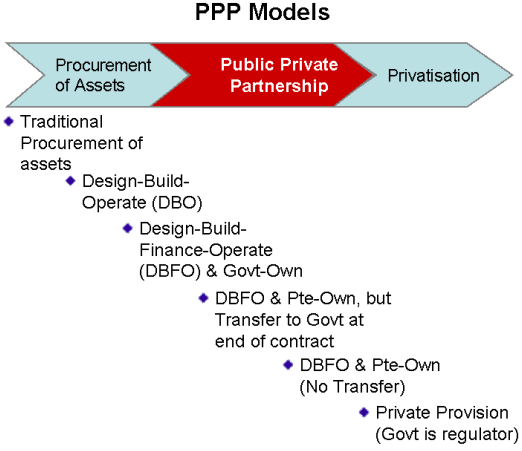
1.2.2 The PPP models are typically a variation of the Design-Build-Finance-Operate (DBFO) model or the Design-Build-Operate (DBO) model.
a) Design-Build-Finance-Operate (DBFO) model. DBFO is the most common form of PPP, involving the integration of these four functions, Design, Build, Finance and Operate, within one PPP service provider. The PPP provider will secure its own financing to build, maintain and operate the facilities to meet the public sector's requirements. The private provider will be paid according to the services delivered, at specified performance standards, throughout the entire contract length.. This ensures optimal use of capital resources in government projects as well as greater certainty over future government cash flows. The approach also transfers financial risks to the private sector, which will do the due diligence to ensure financial viability of the project.
b) Design-Build-Operate (DBO) model. One possible variation to the DBFO model is the DBO model, i.e. the public sector provides the funds for the design and building of the facility, and then continues to engage the same private vendor to operate the facility. The operator is then paid a management fee according to performance standards. This model may be suitable for very large projects for which the private sector is unable to finance wholly.
Besides these models, the public sector is open to any other variations or new PPP models that may be proposed by the private sector.