1.3 What are PPPs?
The World Bank defines PPPs as a "long-term contract between a private entity and a Government Entity, for providing a public asset or service, in which the Private Party bears significant risk and management responsibility, and its remuneration is linked to performance."
PPPs are classified on the basis of three broad parameters - the type of asset involved; what functions the Private Party is responsible for; and, how the Private Party is paid:
a. Asset - many PPPs involve the financing, building, and managing of new public Assets, often called "greenfield" projects; some PPPs involve the transferring of responsibility for the upgrading and managing of existing Assets to a private company, and are known as "brownfield" projects. PPPs tend to be large, capital intensive projects (e.g. roads, bridges, hospitals, metro systems, power plants, waste to energy, water and sewer systems etc.)
b. Function - this can include any or all of the following: design - developing the project from initial concept and output requirements; construction or refurbishment; raising finance; or, the operation, maintenance and removal, demolishment or decommissioning of an asset. In most cases, the private sector is responsible for the long term operation of an asset and provision of a service either to a government off-taker or to end users.
c. Payment mechanism - based on the services provided by the private sector party, the payment to the private sector can be "user pays", or "government pays" or a combination of these:
• "User pays" PPPs - wherein the Private Party provides a service directly to end users and generates revenue by charging end users directly for that service. This revenue may be supplemented by performance-based or output-based payments from the government.
• "Government pays" PPPs - wherein the government is the sole source of revenue for the private sector party, and payments can either depend on the asset or service being available at a contractually-defined quality and period ("availability" payments) or can be output-based for services delivered to users. The Private Party's remuneration is linked to performance.
• "Hybrid" PPPs - wherein Private Party revenue is generated by charging end users directly for providing a service, supplemented by performance-based or output-based payments from the government.
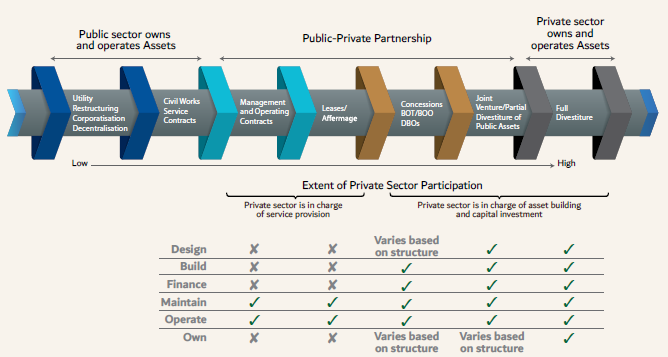
These characteristics can be combined in various ways to create a wide range of PPP contracts; the World Bank classifies PPPs along a spectrum based on the nature of asset ownership and private sector participation as follows:
|
Source: "What are Public Private Partnerships?" World Bank |