3.2.4 Determining Key Stakeholders
It is advised that the PPP Project Team identify key Stakeholders and consult them throughout the project's life cycle in order to better gauge the needs of the project. In order to provide a better understanding of the approvals that will be required and detailed at a later stage, the Government Entity should organise meetings and workshops between the PPP Project Team and the relevant government agencies - Dubai Municipality, Dubai Electricity and Water Authority (DEWA), Dubai Chamber, Road and Transport Authority (RTA) and the Land Department, amongst others - and any other relevant units, as deemed to be appropriate by the Government Entity.
In addition, the PPP Project Team must outline the key relevant Stakeholders on the particular project: for instance, if a hospital is being procured, government agencies such as Dubai Municipality, DEWA, and the Land Department, might have to be involved. In order to ensure that requisite approvals are in place during the course of the procurement, it is of crucial importance that the PPP Project Team seeks them during the initiation stage. This will also reinforce the faith of the private sector in the Government Entity's determination to achieve a smooth and timely commercial and financial close. Additionally, the Government Entity is advised to set up a Point of Contact at each relevant stakeholder Government Entity in order to ensure that liaison between the PPP Project Team and the Government Entity is seamless during the procurement process.
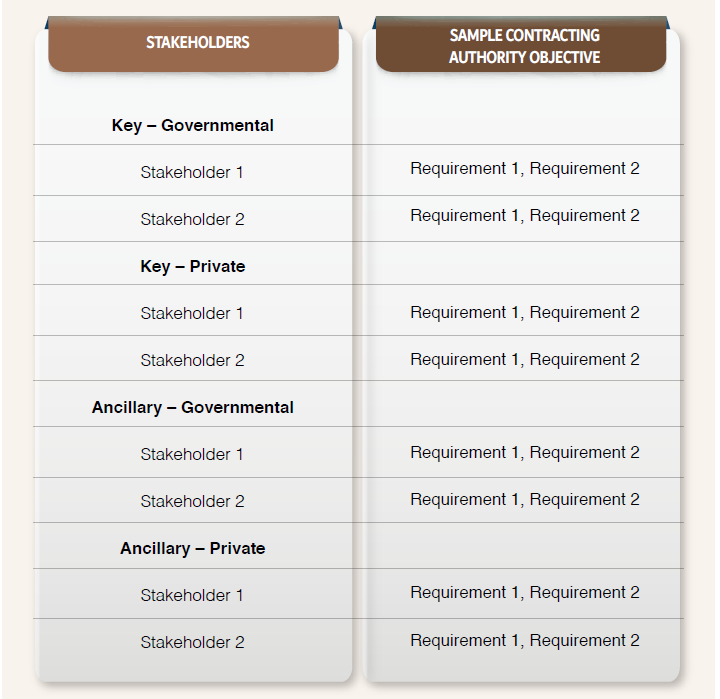
In summary, the PPP Project Team must list all interested parties that may be impacted - positively or negatively - by the project. As illustrated in the table below, the PPP Project Team can categorise the relevant parties as governmental and private, depending on whether they are part of the public sector or not; and, as key or ancillary, depending on their level of involvement in the project.
|
Figure 9: Sample table of key Stakeholders and Government Entity objectives
|