3.2.5 Output Specifications
Under a traditional procurement, the Government Entity prepares a list of detailed specifications that describe the inputs required to be delivered for the provision of a service. On the other hand, under a PPP procurement, the Government Entity prepares a list of output specifications, specifying the services required against which the performance of the private company will be measured in a particular project.
The output specifications underpin the entire PPP procurement process, and, hence, must be outlined with a great deal of attention. The focus of the Output Specifications is on services required rather than on Assets wanted, and the service standards expected by the Government Entity, regardless of who will deliver them. Output specifications should be clear and unambiguous statements that set out exactly what is expected of the Preferred Bidder on the project. These specifications should be drawn from the project objectives. The PPP Project Team is also encouraged to ensure that they are not so detailed as to discourage innovation, which is one of the drivers of achieving Value for Money in PPP Projects. Additionally, output specification should be clearly identified and quantifiable, so as to define relevant performance indicators against which the performance of the private sector partner can be measured.
Key elements of output specifications include:
 Organisational structure of the Government Entity: the structure of the Government Entity needs to be set out, in order to establish the interface between the Bidders and the Government Entity, and offer clarity on communication, reporting, and management protocols;
Performance criteria: determining the required service delivery principles, the operation and maintenance process performance criteria, and the details of monitoring and conformance measures in realistic and quantifiable terms;
Quality standards: the minimum quality criteria that would necessitate adherence from interested Bidders, as determined by the Government Entity. These would include, for example, construction quality requirements when physical structures are involved; hygiene and drug quality standards when medical facilities are involved; sanitation standards when ancillary facilities are involved; or, maintenance and rehabilitation requirements which sets the minimum criteria the Assets needs to satisfy before the private company hands back the Assets to the Government Entity.
Constraints: following extensive discussions with key Stakeholders, any constraints to be placed in the design, construction, and operational phases of the project that may necessitate contractual amendments, are to be detailed;
Risk transfer: the identification, assessment, and allocation of risk between the public and private sectors, in order to ensure an optimum allocation of risk as required by the relevant procurement method;
Payment principles: determine explicit, quantifiable, and pragmatic payment principles;
Change mechanisms: a certain range should be specified for the relevant operating conditions, as determined following extensive consultations with key Stakeholders and the Government Entity, with a provision for direct negotiations should this range be exceeded;
Alternatives: in cases where the Government Entity may recognise that there are certain alternatives that, while not necessarily stated in the Tender documents and specifications, may be worthy of being considered, a general basis for comparison must be evolved; and,
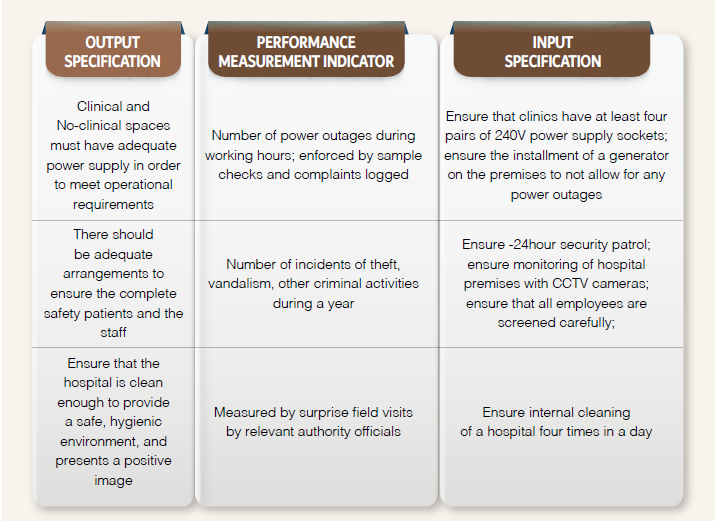
The PPP Project Team is advised to construct a table in order to indicate the list of output specifications, specify the corresponding performance measurement indicator that will be used, and the input specification that could be utilised by interested Bidders in order to address the output required. Provided below herein is an illustrative table for a hospital PPP:
|
Figure 10: Illustrative list of output specifications, performance measurement indicators, and input specifications for a hospital PPP
|