3.3 PPP Options Analysis
Potential PPP options should be evaluated against the objectives of the project, whole-of-life costing, the detailed output specifications, the utility of each option in achieving them in an efficient manner, the feedback from the market sounding, and the qualitative and quantitative risk assessment - details of which can be found in Chapter 5 of this Guidance Note.
While evaluating each delivery option, consideration must be given to:
 The capability of the private sector to deliver its portion of the required work and manage the risks allocated to it;
The ability of the Government Entity to finance and deliver its obligations;
The achievement of strategic and project outcomes, especially those denoted specifically by the Government Entity;
The extent to which the model accounts for exogenous changes in conditions;
Whether the project has any unique characteristics that make it not amenable to traditional methods of delivery; and,
Whether the project has risks that, even if appropriately allocated, exceed organisational or market tolerance levels.
The methods of delivery considered can range from traditional government-funded procurement through to a design, build, finance, operation, and maintenance contract. Based on the benchmarking conducted and extensive consultations with key Stakeholders, the PPP Project Team can prepare a longlist of the delivery models that can be assessed, which will vary according to the nature of the project and will be refined following the market sounding exercise that will aim to gauge the appetite of the private sector to finance and procure such a project.
Below is an illustration outlining the spectrum of possible options:
|
Figure 11: World Bank PPP options spectrum |
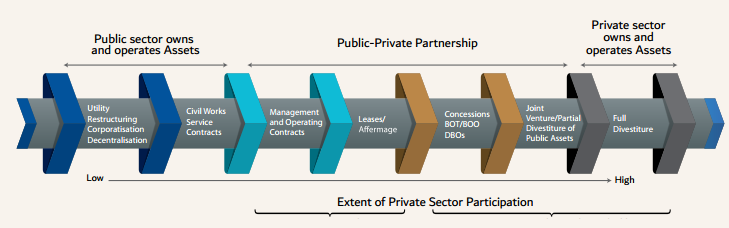
Source: "What are Public Private Partnerships?" World Bank
Moreover, the PPP Project Team should conduct an assessment of whole-of-life costs, including initial capital expenditure, maintenance and refurbishment costs, operational costs, and the cost of any associated enabling works, ensuring that the comparison then made between delivery models is like-for-like, which will then be used to narrow down the longlist.
Choosing the most suitable delivery model depends on the Project's Risk Allocation structure, Opex, Capex assumptions, as well as its technological and design requirements. A brief summary of most common PPP models are exemplified below:
|
Figure 12: Summary of PPP Models |
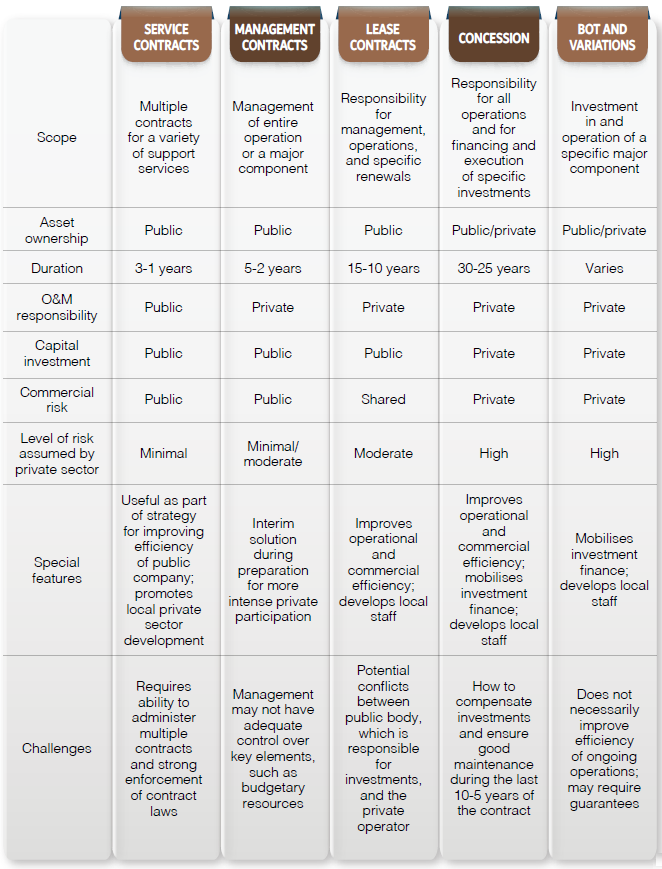
Source: "PPP Options for Toll Road Development", Heather Skilling and Kathleen Booth, 2007