Challenges and Opportunities for Public-Private Partnership in Health
The promotion of PPP in the health sector faces a number of challenges, including the following: (i) a poor understanding of the concept of PPP; (ii) weak institutional capacity of public sector agencies to engage in PPP; (iii) PPPs being initially donor-driven and eventually losing momentum as interest dies down; (iv) political affinities and inability to sustain the PPP beyond the term of the LGU chief executive; (v) non-formal working arrangements between partners, which can result in limited support from one or both partners; (vi) peace and order issues in some places; (vii) limited sustainability of resources; (viii) lack of or weak monitoring; and (ix) prevalence of moral hazards and political influences and practices. In addition, there are numerous private parties that could benefit the public sector but hesitate to engage with public partners. There is, thus, an urgent need to strengthen the capacity of public agencies to manage PPP projects through activities such as drawing up PPP agreements, mentoring them in business planning, and providing support for monitoring and evaluation of the enterprise. There are vast opportunities for creating or expanding successful PPP models, but leadership is a key to success.
These challenges then provide opportunities for the development of PPP enterprises as well as knowledge management resources that will enable institutions to continuously capture lessons and insights from implementation. This guidebook is one of the resources that has been developed under the TA 7257-PHI package. Figure 1 shows an illustration of these knowledge management products.
Figure 1: Knowledge Products Developed through ADB Technical Assistance for Public-Private Partnership in Health
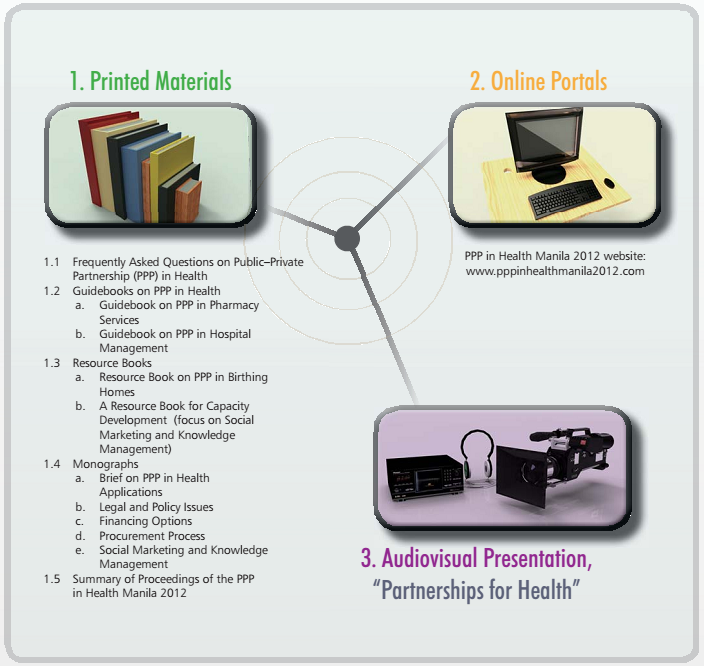
Note: The Frequently Asked Questions on PPP in Health, resources books, monographs, and the Summary of Proceedings of the PPP in Health Manila 2012 are part of the final report on the ADB technical assistance project, Public-Private Partnership in Health in the Philippines.
Source: Asian Development Bank. 2012. Public-Private Partnership in Health. Final Report. Manila.