6.1 About This Step
When public-private partnership (PPP) contracts have been signed, monitoring and evaluation (M&E) will ensure that parties are living up to their ends of the contract and the endeavor is achieving its intended purpose. The ADB Public-Private Partnership Handbook mentions three general forms for monitoring PPP initiatives:
(i) Use of a contract monitoring unit, usually a unit formed within a government unit if a separate regulator is not present. The contract has to contain measurable targets and procedures for measuring and reporting. The unit has to develop a procedures manual for verifying performance against the contract and for responding to any contract deviation. If payments are part of the contract, a method for ascertaining the basis for payments, making payments, reporting, and accounting for payments made is also necessary.
(ii) If a government regulator exists, they should perform the same functions but against existing sector regulations.
(iii) A third option is to contract independent auditors, who can be from either the public or private sector. (In the Philippines, the Philippine Council for Accreditation of Health Organizations may be contacted as an independent auditor.)
Government regulatory bodies may focus on hospital performance and their M&E departments can develop monitoring tools for PPPs in health initiatives. However, their assessments are usually performed only once a year; thus, they may be inadequate for monitoring day-to-day performance of an innovative setup such as a PPP in hospital management in the local governments. The assessment indicators can be discussed with the PPP committee.
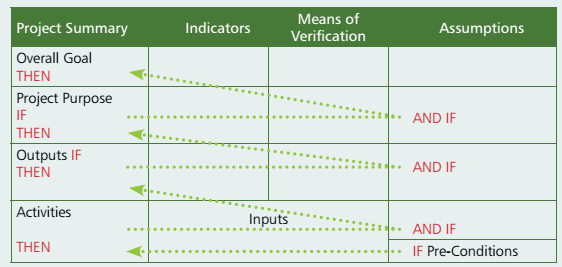
A PPP in hospital management is usually intended as part of a schema or logical framework (logframe) designed to achieve a goal or impact on health in a particular locality or province (Table 3).
The relationship between the columns is illustrated in Table 4.
|
| Table 3: Sample LogFrame Matrix for a Public-Private Partnership in Hospital Management |
| |||
|
| Project Summary | Indicators Effect Indicator: | Means of Verification | Assumptions |
|
|
| Overall Goal Longer-term development goal Necessity of the project (Impact of the project) |
|
|
|
|
|
| Project Purpose Direct effects of the project (positive changes for the target group/area) |
|
|
|
|
|
| Outputs Goods and services created by the project |
|
|
|
|
|
| Activities Actions required for achieving "outputs" | Inputs Physical, financial, and human resources to carry out project activities |
|
| |
|
| Pre-Conditions Conditions to start the project |
| |||
|
| Source: ADB. 2007. Guidelines for Preparing a Design and Monitoring Framework. Manila. |
| |||
|
| Table 4: Sample LogFrame Matrix for a Public-Private Partnership
|
|
| Source: ADB. 2007. Guidelines for Preparing a Design and Monitoring Framework. Manila. |
|
| Figure 3 Logic of Operation/Effect Indicators
|
|
|
| Source: ADB. 2007. Guidelines for Preparing a Design and Monitoring Framework. Manila. |
|
| Box 6: Statements of Goal, Purpose, and Outputs for a Public-Private Partnership in Hospital Management (Sample) Overall goal: Improved maternal mortality rate Project purpose: Provide quality general management and clinical management services to provincial hospital/s especially maternal and child health services. Project output: Hospital managed by a private entity |
| |
| Activities: | (i) Conduct a needs assessment of hospital services (ii) Institutionalize and document management practices (iii) Provide appropriate quality levels for hospital services (iv) Monitor hospital operations | |

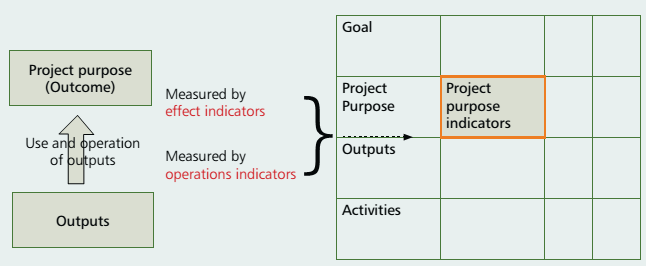
Performance indicators for project purpose or outcome include both operation and effect indicators. An operation indicator is a quantitative measure of the operational status of the project outputs, while an effect indicator is a quantitative measure of effects generated by the project (Figure 3).
Box 6 shows examples of goal statement, purpose, outputs, and activities when a logical framework is applied to a PPP in hospital management. However, the organization must bear in mind that hospital management is much more complex than straight-forward outsourcing of services such as hospital administrative services. The organization and the chosen hospital manager must agree on indicators for both general and clinical management. The considerations in Box 6 are just examples. Bear in mind that the process of formulating an M&E program is the focus here.
Moving further, a framework for a PPP in hospital management may look like the one in Table 5.
|
| Table 5: Logical Framework for a Public-Partnership in Hospital Management with Sample Considerations |
| |||
|
| Project Summary PPP-Hospital Management | Indicators | Means of Verification | Assumptions |
|
|
| Overall Goal Improved maternal mortality rates | Maternal mortality rate | Hospital records | Births in the hospital contribute to a major portion of births. |
|
|
| Project Purpose Provide quality general management and clinical management services to provincial hospital(s), especially maternal and child health services. | (i) Net death rate from deliveries, cesarean sections (ii) Net death rate for children under 5 (iii) Infection rates (iv) PhilHealth Benchbook indicatorsa (Philippine context) | Census from patient charts | Local and external physicians will agree to management setup and indicators. |
|
|
| Outputs Functioning Quality hospital management services provided by a private entity | (i) Contract signed (ii) No non-conformances to contract agreements (iii) Hospital performance indicators | (i) Document copy (ii) Reports (iii) Visual inspection | Both local and external physicians will agree to management setup. |
|
|
| Activities (i) Determine needs and review the hospital services in the area. (ii) Identify stakeholders and their roles. (iii) Develop an implementation plan for the PPP. (iv) Develop a social marketing and promotion plan. (v) Conduct procurement. (vi) Implement the PPP. | Inputs (i) Hospital liaison with local social health insurance offices appointed to ensure prompt reimbursements (ii) Functioning hospital clinical management team committee (iii) Local governments with funds to reimburse non-insured patients' expenses (iv) Hospital services and facilities within national standards | (i) Health department, social health insurance, and audit commission approval of setup (ii) Less than 80% social health insurance enrollment and global budgetingb used. |
| |
|
| Pre-Conditions Provincial government decision to pass a PPP code or resolution through the local council |
| |||
|
| PPP = public-private partnership. a The Benchbook features a list of standards for improving the quality of care in all health care organizations in the Philippines. It goes beyond the usual emphasis on structures (e.g., facilities and equipment) by providing process and performance standards such as waiting time for procedural treatments and business processes. Source: Philippine Health Insurance Corporation (PhilHealth). b A "global budget scheme" is now being developed by Philippine Health Insurance Corporation. This scheme is a modified approach to health financing where accredited health care providers with good performance can negotiate an advance payment for the costs of providing specific packages of medical benefits based on a predetermined and fixed budget. Once implemented, it encourages good performers to continue improving their health services and facilities with the promise of advance payments. |
| |||
The shaded cell in Table 5 contains indicators that are critical in monitoring how the hospital is performing and consequently how the PPP is faring. Partners need to agree on performance indicators, examples of which are listed below (under tools and requirements).