The use of PFI and PF2
1.4 Under PFI schemes, private investors finance public sector capital projects in exchange for a financial return from the taxpayer once the project is delivered. The government has used PFI and its successor PF2 to build assets since the 1990s, while continuing direct public financing of many other projects. The Royal Liverpool project was a PFI while Midland Metropolitan was set up as a PF2, the main difference being that the government took a minority equity stake in the latter, managed by the Infrastructure and Projects Authority (IPA) in the Cabinet Office. In 2018 we reported that there were more than 700 operational PFI deals, with the Department of Health & Social Care (the Department) using PFI for 127 projects.3 In this report we use 'PFI' to refer to both PFI and PF2 schemes.
1.5 Departments were able to use PFI until 2018 when government policy changed. PFI involves the use of private finance, which costs more than normal government borrowing. But HM Treasury believed that this cost could be outweighed by the other benefits of allocating risk to the most appropriate party through the use of PFI, including greater certainty over construction costs, better governance and due diligence over the project, improved operational efficiency and higher-quality, well-maintained assets. In 2009 we reported that PFI construction projects were being delivered to timetable in more than two thirds of cases and to price in around half.4 However, the use of PFI has been controversial. The House of Commons Public Administration and Constitutional Affairs Committee reported in July 2018 that its advantages remained unproved.5 The Chancellor of the Exchequer announced in October 2018 that the government would abolish the use of PFI and PF2 for future projects.
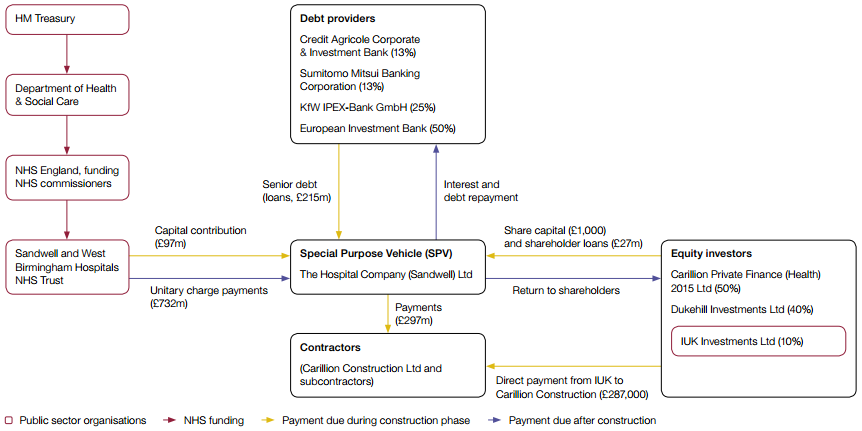
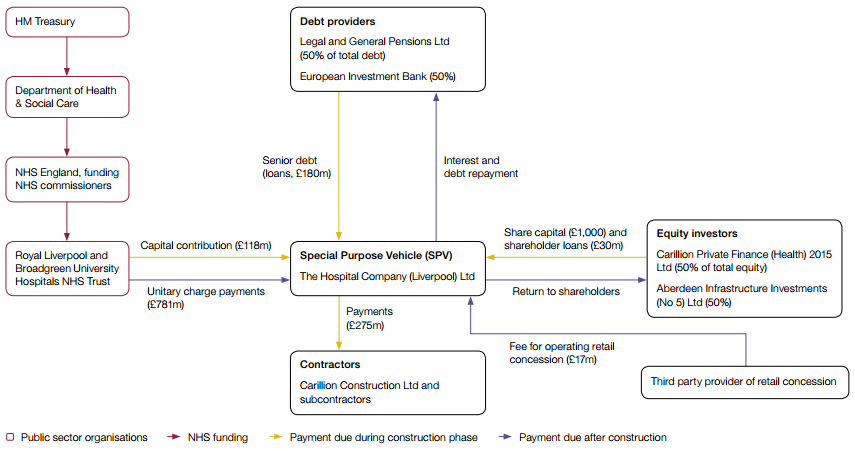
1.6 Carillion was chosen to build Royal Liverpool by the Royal Liverpool University Hospitals NHS Trust (the Liverpool Trust), and to build Midland Metropolitan by the Sandwell and West Birmingham Hospitals NHS Trust (the Sandwell Trust), following open competitions. It had a dual role in the two hospital PFI schemes, as the lead construction contractor and as a major shareholder in the private companies responsible for the projects. Figures 2a and Figure 2b on pages 16 and 17 show the structures of the two PFI schemes including the PFI companies (or Special Purpose Vehicles), which raised finance from debt and equity investors to pay for each hospital's construction. The investors' returns were expected to come from monthly 'unitary charges', which the Trusts would start to pay once the hospitals opened.
1.7 The Trusts had contracts with the PFI companies to deliver the hospitals. The Trusts' management boards received regular updates on progress and approved key decisions. Several central government bodies (the Departments) were also involved in oversight of the two projects:
• the original business cases for the projects were approved by the then Department of Health and HM Treasury;6
• under the PF2 model used for Midland Metropolitan, two civil servants from the Cabinet Office's Infrastructure and Projects Authority (IPA) were directors of the PFI company (The Hospital Company (Sandwell) Ltd); and
• until early 2015, the hospital projects were included in the Government Major Projects Portfolio (GMPP) which is overseen by the IPA. They were removed from the GMPP at the request of the Department of Health, as responsibility for the projects lay with the Trusts and not the Department, following the Health and Social Care Act 2012 which provided for widespread reform of the health system in England.7
| Figure 2a The Private Finance Initiative (PFI) scheme for Midland Metropolitan The scheme was to be financed by both the public and private sectors
Notes 1 The Midland Metropolitan project used a 'PF2' model in which government takes an increased role compared to 'classic' PFI, including two Cabinet Office civil servants being directors of The Hospital Company (Sandwell) Ltd. 2 As part of the PFI agreement, IUK Investments Ltd and Dukehill Investments Ltd paid a premium for purchasing the shares. IUK's share was paid direct to Carillion Construction. 3 The figure shows the cash to be provided without adjusting for inflation or the time value of money. Not all the proposed cash from equity and debt providers or the trust was received before Carillion went into liquidation. Carillion's liquidation meant it was unable to provide its share of the shareholder loan, but an equivalent amount had been lent by banks under a temporary facility known as an equity bridge loan. 4 The Hospital Company (Sandwell) Ltd is referred to as 'the PFI company' in this report. Source: National Audit Office analysis of scheme's financial information |
| Figure 2b The Private Finance Initiative (PFI) scheme for Royal Liverpool The scheme was to be financed by both the public and private sectors
Notes 1 In December 2017, Aberdeen Asset Management sold its 50% shareholding in the Hospital Company (Liverpool) Ltd to the Pension Infrastructure Platform (PiP). 2 The figure shows the cash to be provided without adjusting for inflation or the time value of money. 3 The Hospital Company (Liverpool) Ltd is referred to as 'the PFI company' in this report. Source: National Audit Office analysis of scheme's financial information |
___________________________________________________________________
3 Comptroller and Auditor General, PFI and PF2, Session 2017-2019, HC 718, National Audit Office, 12 January 2018.
4 National Audit Office, Performance of PFI Construction - a review by the Private Finance Practice, October 2009.
5 House of Commons Public Administration and Constitutional Affairs Committee, After Carillion: Public sector outsourcing and contracting, Seventh Report of Session 2017-2019, HC 748, 3 July 2018.
6 The Department of Health is now the Department of Health & Social Care.
7 Comptroller and Auditor General, Projects Leaving the Government Major Projects Portfolio, Session 2017-2019, HC 1620, National Audit Office, 19 October 2018.