Termination of the Royal Liverpool PFI scheme
2.20 Members of the recovery group looked into two options for termination:
• Pursuing a termination under the contract for default. In line with the standard PFI contract, this would require the Trust to provide at least 80 business days' notice to the lenders of their intention to terminate the contract. The Departments also believed that there was a risk lenders would further delay the termination through a formal dispute or legal action and that the lenders could mothball the site and abandon the existing contracts, causing additional damage, cost and delay.
• Agreeing a consensual termination with the lenders. This would bypass the full process set out in the contract and the potential for a dispute or litigation. It would also allow the Trust quicker access to the site, allow the existing contractors to be transferred (novated) to the Trust, and allow work to continue immediately.
2.21 The Department of Health & Social Care and the IPA estimated that a termination for default would lead to a lower amount of compensation for the lenders but that avoiding the delay and cost of litigation under a consensual termination would leave the Trust better off so long as the settlement was £51 million or less. The Department of Health & Social Care and the IPA therefore suggested to the Trust that it seek a quick negotiated settlement of the compensation, including the transfer (novation) of the Laing O'Rourke contract from the PFI company to the Trust to enable construction to continue without a break.
2.22 After negotiation, the Departments, the Trust and the lenders agreed that the Trust would pay the lenders £42 million. This was paid in October 2018, funded by the Department of Health & Social Care once the Trust, the lenders and the Departments had agreed to terminate the PFI contract.
2.23 In their negotiation of the £42 million termination payment, the Department of Health & Social Care and the IPA used the contractual approach as a benchmark. According to the PFI contract, the Trust would be required to pay compensation to the PFI company for early termination of the contract. In general terms, this is calculated by subtracting the estimated costs of completing the hospital from the value the lenders could expect to receive over the course of the contract, once the hospital was built.
2.24 In calculating the £42 million termination payment, the Department of Health & Social Care and the IPA had to use information provided by the PFI company, the lenders and the lenders' advisers. They received various updates on the cost to complete in the run-up to agreeing the termination payment and the actual value to use was highly uncertain. For example, on 3 September the PFI company wrote to the Department of Health & Social Care and the IPA that it was "impossible to conclude" what the cost to complete was likely to be because the number of problems with the beams had increased and the external cladding had failed to meet building regulations and may have to be replaced. The Arup report on structural issues was still in draft in September 2018 and the lenders only gave the Trust a limited opportunity to review the draft before termination.
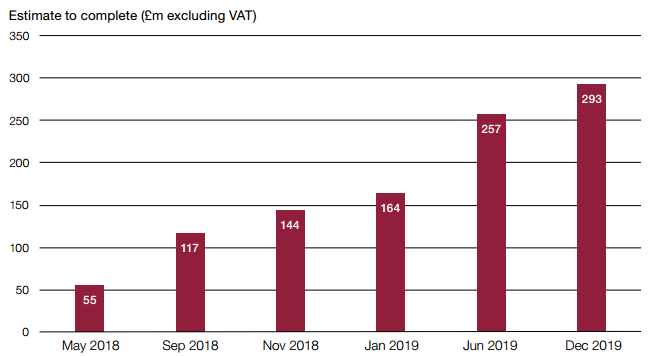
2.25 The Department of Health & Social Care and the IPA told us that they calculated the value-for-money case for offering £42 million using an estimate of the present value cost to complete the hospital of £105 million, based on information provided by the lenders and their advisers in late September. They then added a £12 million (present value) allowance for the risk that it might be higher than this, giving a present value cost to complete of £117 million. The business case submitted to ministers also stated that the cost to complete could be lower than £117 million and did not test what would happen if it were even higher.
2.26 Estimates of the cost of completing the hospital continued to rise through 2018 and into 2019 (Figure 6). By January 2019, following further work by Arup and others, the Trust estimated the completion cost had risen to £164 million. Had this estimate been used it would have reduced the contractual compensation to zero. By December 2019 the completion cost estimate had risen to £293 million, including the current estimated cost of fixing the cladding (Figure 6 and paragraph 1.19).
Figure 6 Royal Liverpool estimated cost to complete - May 2018 to December 2019
Notes 1 All numbers are taken from different documents and it is not clear from the documents that they are on a strict like-for-like basis. All numbers are estimated construction cost net of VAT. 2 May 2018 figure from the Royal Liverpool construction update May 2018. 3 September 2018 figure from Infrastructure and Projects Authority and Department of Health & Social Care value-for-money analysis, base case. 4 November 2018 figure following due diligence by the Liverpool Trust on the PFI company's figures. 5 January 2019 figure from the January 2019 draft business case cost to complete. 6 June 2019 figure from the June 2019 final business case cost to complete. 7 December 2019 figure from the Trust's latest forecast (stated in 2018-19 terms) following assessment of cladding costs. Source: Departments' reports to ministers, Liverpool Trust board papers, forecasts and business cases |
2.27 The lenders demanded that the payment be finalised before 30 September 2018, the date the contract required the PFI company to provide the finished hospital before it was in default. The Department of Health & Social Care and the IPA told us that they were not able to negotiate making the payment contingent on the actual completion cost.