Rising cost of backlog maintenance
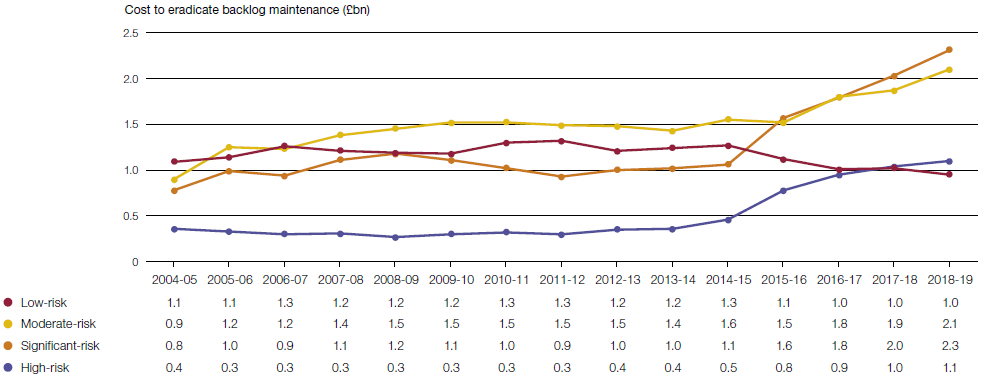
1.4 Backlog maintenance is a measure of how much spending is needed to restore NHS buildings to an appropriate standard. An appropriate standard includes the physical condition of the estate, as well as compliance with fire safety and health and safety standards. Backlog maintenance is classified into four categories: low-, moderate-, significant- and high-risk (Figure 2). The total cost of backlog maintenance estimated in 2018-19 is £6.5 billion. This comprises: £1.0 billion for low-risk maintenance; £2.1 billion for moderate-risk maintenance; £2.3 billion for significant-risk maintenance; and £1.1 billion for high-risk maintenance.
1.5 High-risk backlog maintenance grew by 139% between 2014-15 and 2018-19. High-risk is defined as "where repairs/replacement must be addressed with urgent priority in order to prevent catastrophic failure, major disruption to clinical services or deficiencies in safety liable to cause serious injury and/or prosecution".
| Figure 2 Significant-risk and high-risk backlog maintenance has increased by 118% and 139% respectively since 2014-15 |
|
|
| Notes 1 Definitions of high-risk, significant-risk, moderate-risk and low-risk are reproduced below from NHS Improvement's Estates Returns Information Collection (ERIC) 2017-18, Data Fields and Definitions; available at: https://files.digital.nhs.uk/8D/8DF512/ERIC-2017-18-Data%20Definitions%20v2.pdf 2 High-risk is defined as where repairs/replacement must be addressed with urgent priority in order to prevent catastrophic failure, major disruption to clinical services or deficiencies in safety liable to cause serious injury and/or prosecution. 3 Significant-risk is defined as where repairs/replacement require priority management and expenditure in the short term so as not to cause undue concern to statutory enforcement bodies or risk to healthcare delivery or safety. 4 Moderate-risk is defined as where repairs/replacement require effective management and expenditure in the medium term through close monitoring so as not to cause undue concern to statutory enforcement bodies or risk to healthcare delivery or safety. 5 Low-risk is defined as where repairs/replacement require to be addressed through agreed maintenance programmes or included in the later years of an Estates Strategy. |
| Source: National Audit Office analysis of NHS Digital's Estates Return Information Collection (ERIC) data 2004-05 to 2018-19 |