Capital spending plans
2.2 Spending reviews set out the government's plans for spending over several years. The allocation of funding then follows a process where the government sets out, and Parliament authorises, the maximum amount each department can spend annually. This is known as the Departmental Expenditure Limit (DEL) and cannot be exceeded without further approval from Parliament. The DEL is split between revenue and capital spending. Revenue spending is for day-to-day activities, for example staffing, while capital spending is for investment, for example land, buildings and equipment.
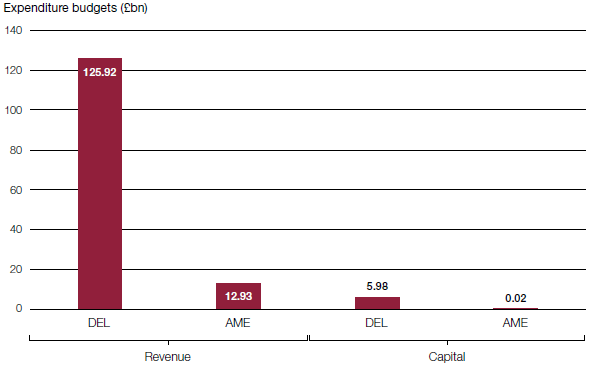
2.3 In 2018-19 Parliament authorised a DEL for the Department of £132 billion (Figure 5). Of this, £126 billion was for revenue spending and £6 billion for capital spending. A further £13 billion was allocated for demand-led spending that is mostly outside of the Department's control - this is known as Annually Managed Expenditure (AME). AME includes items for which the timing and amount are difficult to predict, for example clinical negligence claims.
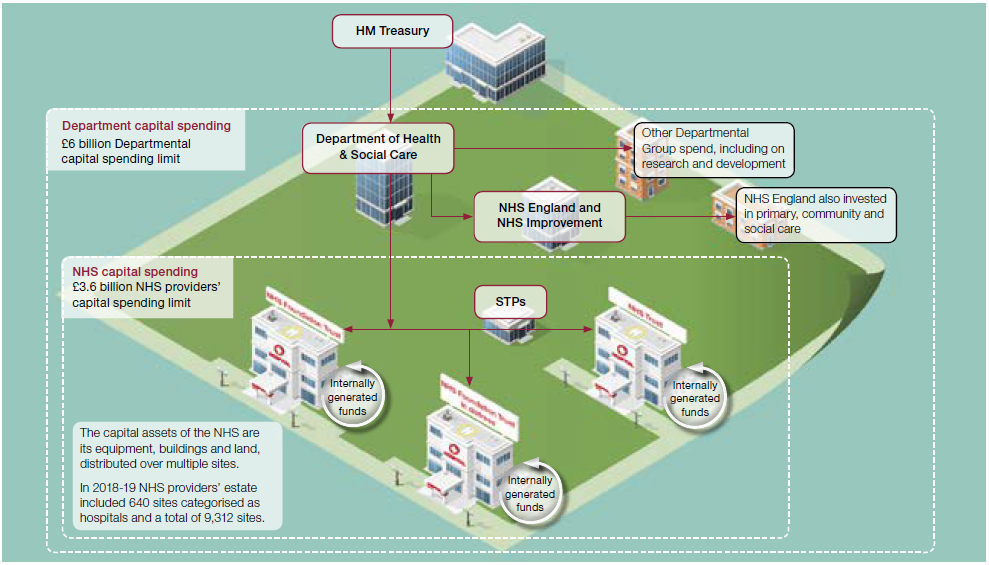
2.4 Of the Department's £6 billion capital spending limit in 2018-19, £3.6 billion was for NHS trusts and NHS foundation trusts (NHS providers) as shown in Figure 6 on page 18. The Department retains the accountability for the overall capital limit while NHS England and NHS Improvement (NHSE&I) are involved in the planning, coordination and authorisation of capital. In 2019-20 NHSE&I also involved sustainability and transformation partnerships (STPs) in the planning of NHS capital on a regional basis for the first time. STPs are non-statutory bodies comprising clinical commissioning groups, NHS providers, local authorities, the voluntary sector and other bodies brought together to plan and deliver services across 42 geographical footprints in England. The more advanced STPs have become integrated care systems, defined by closer collaboration between organisations with greater freedoms to manage the operational and financial performance of services.
| Figure 5 Capital is a relatively small but strategically important part of the Department of Health & Social Care's spending |
|
|
| Source: National Audit Office analysis of the Department of Health & Social Care Annual Report and Accounts, 2018-19 |
2.5 Figure 6 shows the three categories of NHS provider in the capital planning system, which includes NHS foundation trusts, NHS foundation trusts in financial distress and NHS trusts. Organisations in these last two categories must seek approval from NHSE&I for different levels of capital spending and have different freedoms for generating and spending capital.
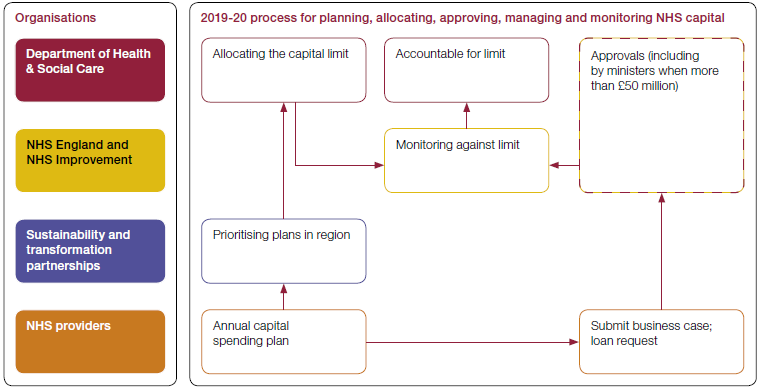
2.6 Many organisations share some of the responsibility for the planning, allocation and management of NHS capital (Figure 7 on page 19). The capital arrangements contrast with the more straightforward revenue side of NHS funding, where NHS England is responsible for both transparently allocating revenue funding to the NHS through clinical commissioning groups and ensuring overall NHS financial balance. The stated reason that NHS England is in charge of allocating revenue funding is that "this prevents any perception of political interference in the way that money is distributed between different parts of the country".
| Figure 6 |
| Of the Department of Health & Social Care's (the Department's) £6 billion capital spending limit in 2018-19, £3.6 billion was for NHS trusts and NHS foundation trusts (NHS providers) |
|
|
| Note 1 Sustainability and transformation partnerships (STPs) are non-statutory regional bodies, included as they have been given responsibility for regional control totals in 2019-20. |
| Source: National Audit Office analysis of Department of Health & Social Care, Annual Report and Accounts 2018-19; NHS Improvement Capital Regime and NHS Digital's 2018-19 ERIC data |
| Figure 7 Multiple organisations have some responsibility for planning, allocating, approving, managing and monitoring NHS capital |
|
|
| Source: National Audit Office analysis of 2019-20 NHS capital regime |