2.1 The research brief
The scope of work undertaken by The University of Melbourne and Drum Advisory was agreed upon by Infrastructure Partnerships Australia and the Treasury departments of Queensland, New South Wales, Victoria and New Zealand. The scope agreed was:
1. assess whether mature social infrastructure PPPs are meeting the service delivery outcomes for service provider and contract manager groups set out in contractual agreements, media releases and other community information documents
2. compare, where data is available, service provider and contract manager satisfaction with PPP assets and service delivery to that of traditionally procured and delivered assets and services
3. identify what factors contribute to positive service provider satisfaction in PPPs and what factors can be attributed to poor service provider experiences
4. assess whether value for money (VFM) is maintained over the long-term operating phase of social infrastructure PPP facilities, and
5. provide any recommendations for future PPP projects.
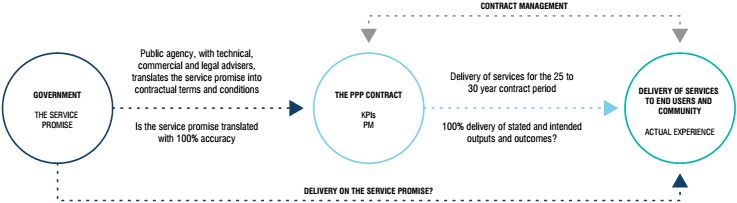
As Figure 2 illustrates, the focus of the report is to assess whether the service promise, as made by government to service providers and the general community, has been filled through:
• the drafting, negotiation and execution of the PPP contract, and
• the performance of the contractual obligations (particularly the Key Performance Indicators (KPIs) and the Payment Mechanism (PM)) as managed by the public agency's contract manager and the PPP Project Co's FM operator.
The judgements of the contract managers were observed to be heavily based on formal assessments of whether KPI targets were achieved and other contractual obligations. Conversely, those of the service providers were based on a largely ex- contractual assessment of how well their service needs, and those of their client community, were being fulfilled. This less formal type of assessment, which can be expected to closely correspond with the views of the general public towards PPP projects, is most useful to understanding how well the PPP procurement model is meeting identified service needs.
Figure 2: The service promise in context