3.1 The PPP projects have delivered on the service promised
Finding 1 Service providers (95 per cent) stated that their PPP project has delivered on the service promised by the relevant state government and delivery agency. |
Both service provider representatives and governmental contract management staff, were assessed as to whether their PPP project has delivered on the project commitments, through a series of questionnaires and workshops. The specific service commitments were made by way of business cases, key media releases, major project documentation and other relevant official communications such as Auditor General Reports. The service commitments are paraphrased in Appendix D.
While commitments were specific to each project, there was constancy regarding quality of the facilities, high service standards, whole-of-life expertise, 'value for money' and professional facilities management. While some commitments were contractually measurable, others were assessed by service provider's perceived satisfaction level.
Many of the commitments made related to physical scale of the project, such as the minimum number of hospital beds or capacity of a convention centre and such obligations were reported to have been always fulfilled by PPP Co. Indeed, the acceptance of these deliverables formed the basis of commercial acceptance of the project, and many projects received industry recognition through a range of awards.
Contract managers consistently advised that pricing and risk allocations remained as per the original agreements, and that the private sector had not sought variations against the original agreement unless government requested a modification or service change. This was measured by comparison of governments' original estimate of the price of the service compared to the price offered by the winning consortium. Appendix D details the savings claimed for the various case study projects. The contract managers and the project documentation also confirmed that it was common for abatements to be applied if services were not received in accordance with the agreement.
In addition to the straightforward assessment of tangible physical scale or contract value commitments, the study also appraised the perceptions of service providers and contract managers. Participants were tested to see whether their level of satisfaction with the services of the PPP model were as promised. As Figure 4 shows the overall satisfaction tends toward participants being highly satisfied.22 This aligns with the commitment of 'enhanced services' through the PPP model.
Figure 4: Perceived satisfaction level of social PPP projects23
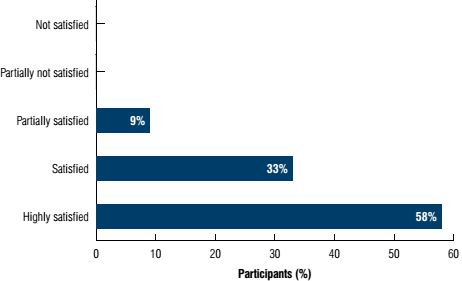
The service providers overwhelming reported that their PPP project has achieved the service and consequent benefit outcomes promised. Contract managers also reported that PPP projects had delivered on the service commitments made by government and others at the stage of project announcement and during establishment. A common theme was that the PPP projects are working very well, and on balance were providing superior service outcomes for the service providers and their client community.
Contract managers made references to issues ("rough edges") that needed on-going management of the contract relationship to ensure optimal delivery of services by the FM operator. However, these same contract managers reported their PPP projects were delivering to government a good deal and in some cases exceeding expectations. They reported instances of innovations that improved the value proposition for government.
There was near universal agreement among school- based service providers that the PPP model had delivered on the service commitments made by government and others at the stage of project announcement. They reported modern leading edge, fit for purpose facilities combined with a flexibility of operation that allowed for changes to be made. For example, among school-based service providers a key commitment met was to significantly free up the time of school principals for educational leadership. Principals reported that when the new school opened significant extra time compared to the non-PPP school setting was released for immediate pedagogy leadership rather than on FM issues.
Typical of the general view, service providers generally observed that in PPP facilities things get fixed quickly. Some school-based service providers observed that the older PPP buildings look better than some of the new facilities procured by traditional models. One group of school principals stated that they have not been on a security or FM related call-out for 10 years. A school business manager estimated that her time devoted to FM issues had reduced by 30 per cent. Service providers generally appreciated the time and effort in shifting to the FM operator the security clearance of all FM personnel coming on-site.
While service providers felt that the service commitment was met, some felt that the service promise should be built from bottom-to-top, with the reality being often top-to-bottom. Most service providers reported that they were not consulted on the contracted KPIs and the payment mechanism. However, this was not identified as a significant issue in levels of overall satisfaction.