4.6 Is there a honeymoon period?
In workshops, where the views of the participants were explored in some detail and issues were assessed on levels of impact, the service providers and contract managers did not believe that there was an early period of exceptional service driven by a freshness and enthusiasm for a new project, which was then followed by fatigue and ordinary service levels in the years following commissioning. In the workshops, the judgement of service providers ranged from exceptional service being a constant over a period of many years to one project where ordinary service was the constant.
However, outside the workshop context, the polling of service providers showed that while nearly all prefer to work in PPPs projects to traditional procured projects, there were some frustrations experienced as the projects mature. This reduction in levels of satisfaction trends from a score of 4.6 to 4.0 or by 12 per cent. Figure 6 shows the trend of satisfaction level among service providers over time based on scores weighted 50 per cent survey and 50 per cent workshop.28
Figure 6: Satisfaction levels expressed by service providers over years of project operations
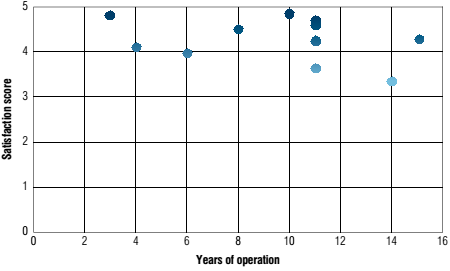
It can be noted from Figure 6 that 10 out of 12 social PPP projects displayed a high level of performance, while two projects displayed satisfactory performance when compared to the selected pool of projects.
It is possible that some part of this observed reduction in levels of satisfaction can be explained by service providers becoming acclimatised to a certain level of performance and perceive a constancy as a lack of improvement over time and hence a deterioration.29 The contract managers, in managing contracted service levels and KPIs, did not highlight a reduction.
Some service providers stated that the important issue was not fatigue but staff turnover that impacted the on-site FM operator service. These service providers felt that the FM operator should recruit and retain suitable people to minimise the disruption that come with the loss of corporate memory and the loss of investment in productive on-site relationships.
One contract manager observed that after a number of years of operations, the risk emerged of relationships and processes becoming set or cosy with a business- as- usual mode of thinking. The view here beings that occasionally contract management may need a reset and that perhaps a new contract manager, with a refresh reading of the Deed Poll, may be beneficial to achieve new levels of service and achievement.