The PFI model
1.2 PFI is an infrastructure delivery model that aims to leverage the skills and resources of the private sector. Over the past 25 years, government used this model to finance, build, maintain and operate assets such as roads, schools and hospitals - there are currently more than 700 operational PFI contracts in place across the UK with a capital value of £57 billion.2 We have reported on PFI contracts extensively in the past (Appendix Three) and recently described how the PFI model works in our January 2018 report PFI and PF2.3
1.3 In 2018, government withdrew the PFI model for all new investments while continuing to honour existing operational PFI contracts.4 Existing PFI contracts remain in place and the public sector continues to pay for these, with ongoing commitments (unitary charges) to pay £168 billion over the next 30 years from 2020-21 onwards - an average of £5.6 billion a year.5
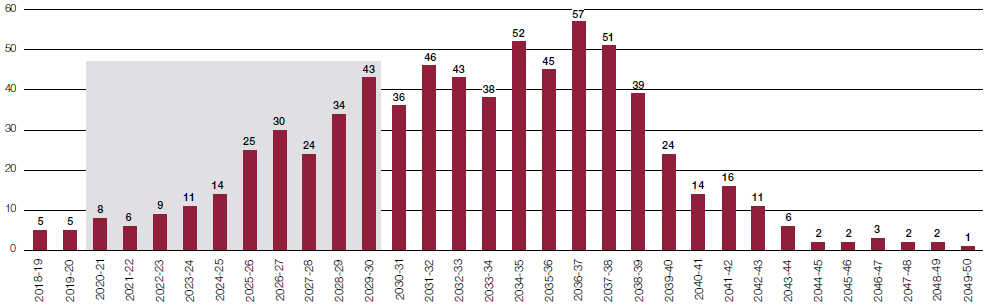
1.4 PFI contracts typically have a 25- to 30-year operational term and only a few have expired so far but this will increase significantly from 2024-25 onwards (Figure 1). In the five years to 2024-25 an average of 10 contracts will expiry annually. This increases to an average of 31 contracts in each of the five years between 2025-26 and 2029-30. We estimate that over the next 10 years 204 PFI contracts will expire, covering assets with a capital value £11.7 billion.6 The 10 largest PFI contracts ending in the next 10 years are listed in Appendix Two.
Figure 1 Timeline for private finance initiative (PFI) contracts that will expire by 2049-50 Over the next 10 years more than 200 PFI contracts will expire1 Number of PFI contracts expiring
Notes 1 Data covers all PFI contracts across the UK. The shaded area represents the contracts ending over the next 10 years (204 contracts). 2 The above data are an estimate produced by the National Audit Office based on HM Treasury's 2018 PFI database and the year the final unitary charge payment is made. Source: National Audit Office analysis of HM Treasury's 2018 PFI database |
1.5 We have described the potential benefits of PFI in our report 'PFI and PF2'.
In summary, these are:
• certainty over construction costs;
• improved operational efficiency; and
• higher quality and well-maintained assets.
We previously reported there is a lack of data to demonstrate whether these benefits have been realised.7 However, as PFI contracts expire, it provides an opportunity to examine whether the assets being returned to public sector ownership are higher quality and better maintained than public sector equivalents.
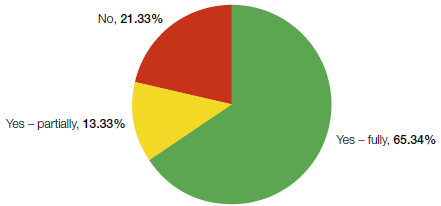
1.6 At the end of a PFI contract, the assets typically return to the public sector. In our survey, 79% of respondents indicated that the assets will either fully or partially return to the public sector upon expiry (Figure 2).8 In the next seven years, reverting assets represent a capital value of £3.9 billion.9
Figure 2 Survey results showing the percentage breakdown of asset ownership on expiry of private finance initiative (PFI) contracts In 79% of contracts surveyed, the assets did or will either fully or partially revert to public sector ownership1
Note 1 Survey results relate to question 4: On contract expiry, did or will the asset(s) (school, hospital, road, etc) transfer to the authority? Number of responses: Yes - 49, Partially - 10 and No - 16. Source: National Audit Office private finance initiative expiry survey |
______________________________________________________________________________________
2 Capital value figure is in nominal terms, representing operational PFI contracts as at 31 March 2018.
3 Comptroller and Auditor General, PFI and PF2, Session 2017-2019, HC 718, National Audit Office, January 2018.
4 HM Treasury, Budget 2018, HC 1629, October 2018, para 1.51, p.29. In December 2012, following a 12-month consultation process, HM Treasury launched Private Finance 2 (PF2) as the successor to PFI. This was in response to concerns that the PFI model was too costly, inflexible and opaque. Only six PF2 projects reached financial close before HM Treasury withdrew the model in Budget 2018. Despite the minor differences between PFI and PF2, we do not separate the two models throughout this report.
5 Figures are in nominal terms.
6 See footnote 5.
7 See footnote 3.
8 Question 4: On contract expiry, did or will the asset(s) (school, hospital, road, etc) transfer to the authority? Number of responses: Yes - 49, Partially - 10, No - 16, 59/75 = 78.67%.
9 Figure is in nominal terms.