Central government support
1.13 The high level of devolved responsibility for the projects, the varied nature of projects and high level of pre-standardisation of contracts makes it challenging for government to take a standardised approach to managing the early expiry of PFI contracts. Poor management of contract expiry can lead to assets being returned to the authority in a worse condition than stipulated in the contract. This could lead to additional funding requirements in order to pay for repairs and maintenance that the SPV should have carried out.
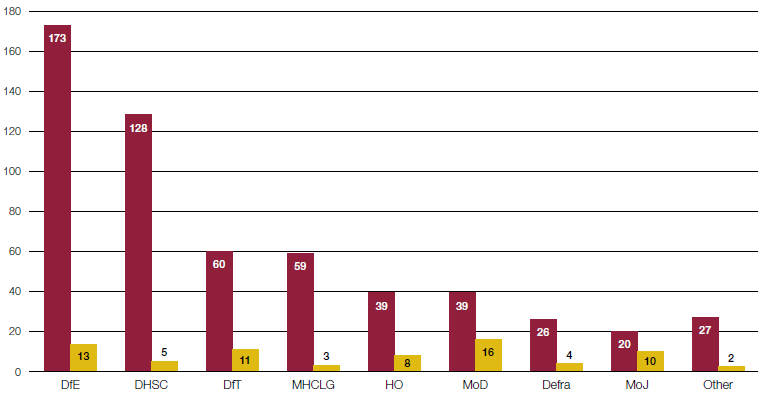
| Figure 5 Estimate of the total number of private finance initiative (PFI) contracts outstanding by department The Department for Education and the Department of Health & Social Care sponsor the most PFI contracts across government Number of PFI contracts
■ Total number of PFI projects outstanding ■ Number of PFI projects expiring between 2020-21 and 2026-27 Notes 1 Total number of PFI projects excluding contracts in Scotland, Wales and Northern Ireland. 2 Total number of PFI projects is in line with HM Treasury's 2018 PFI database. Between 31 March 2018 and the time of publication, a small number of PFI contracts have expired. The total number of PFI contracts expiring between 2020-21 and 2026-27 differs to the number of contracts in our survey which includes projects expiring in the next seven years, plus those that have already expired. 3 Data covers departments that are responsible for PFI projects either as an authority or sponsor department. 4 Data are NAO estimates based on the year of the final unitary charge payment. 5 DfE = Department for Education; DHSC = Department of Health & Social Care; DfT = Department for Transport; MHCLG = Ministry of Housing, Communities & Local Government; HO = Home Office; MoD = Ministry of Defence; Defra = Department for Environment, Food & Rural Affairs; and MoJ = Ministry of Justice. 6 The 'other' category includes the following departments: Department for Digital, Culture, Media & Sport, HM Revenue & Customs, Department for Work & Pensions, Security and Intelligence Agencies, HM Treasury, Department for Business, Energy & Industrial Strategy, Foreign & Commonwealth Office and the Cabinet Office. Source: National Audit Office analysis of HM Treasury's 2018 PFI database | ||||||||||||||||||||||||||||||||||||||||
| Figure 6 Breakdown of all private finance initiative (PFI) projects and those included in our survey sample, by project type Accommodation-type projects represent the majority of PFI assets across the total population and within our survey sample, with 81% and 65% respectively
Notes 1 'Accommodation' includes projects such as hospitals, schools, offices and military facilities, and much of this is generally known as 'social infrastructure'. 2 Ministry of Defence PFI contracts are split between the 'defence', 'accommodation' and 'waste' categories. 3 'Other' includes projects such as street lighting, rail, vehicles and emergency services. 4 Data excludes PFI contracts entered into by the devolved governments of Scotland, Wales and Northern Ireland. 5 Data represents the position as at 31 March 2018 in HM Treasury's 2018 PFI database. 6 Some numbers may differ due to rounding. Source: National Audit Office analysis of HM Treasury's 2018 PFI database | ||||||||||||||||||||||||||||||||||||||||
1.14 Those departments with the most contracts, either as authorities or sponsor departments, are starting to prepare for the PFI expiry process but the extent of these preparations varies significantly. These departments tend to be reactive to demands by authorities rather than proactively seeking out those PFI projects or authorities most at risk (Figure 8 on pages 22 to 24).
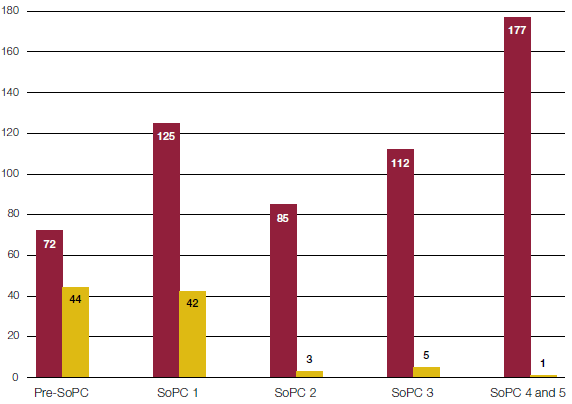
| Figure 7 Estimated breakdown of private finance initiative (PFI) projects, overall and in the survey sample, by the version of standardised contract guidance used Around 45% of contracts in our survey were procured before standardised contract guidance was introduced by HM Treasury and therefore contain a higher risk of ambiguity Number of PFI contracts
Version of HM Treasury's Standardisation of PFI Contracts (SoPC) guidance ■ Total number of PFI contracts ■ Number of PFI contracts in National Audit Office survey sample Notes 1 Data excludes PFI contracts entered into by the devolved governments of Scotland, Wales and Northern Ireland. 2 Authorities procuring a PFI contract would have used guidance known as the Standardisation of PFI Contracts (SoPC). This guidance was first published in 1999. There have been multiple iterations of this document including SoPC 1 (1999), SoPC 2 (2002), SoPC 3 (2004), SoPC 4 (2007) and SoPC 5 (2012). The PFI model was first used in the early 1990s meaning the early PFI contracts were produced without any standardised guidance. SoPC 5 relates to PF2 projects - only six projects were procured under this model. SoPC 3.5 has been combined with SoPC 3. 3 There is no data on the type of SoPC used for each contract. The above data are estimates based on the publication date of each version of the SoPC and the date the PFI contracts were entered into, also known as financial close. 4 Around 45% is based on 44 Pre-SoPC contracts out of 95 PFI contracts in our survey which have not expired at the time of the study (44/95=46.3%). The survey covers 107 PFI contracts; however, HM Treasury's 2018 PFI database contains insufficient data to produce an estimate for 12 expired contracts. These 12 contracts are excluded from the data above. Source: National Audit Office analysis of HM Treasury's 2018 PFI database | |||||
| Figure 8 Summary of private finance initiative (PFI) projects and expiry preparations by department There is significant variation across departments for the PFI expiry process, both in terms of approach and preparedness | |||||
| Department | Number of operational PFI projects | Capital value of PFI of PFI projects (£m) | Summary of departmental PFI contract expiry preparations | ||
| Department for Education (DfE) | 173 | 8,525 | 168 | 6 | DfE sponsors the largest number of PFI contracts and most are managed at a local level. Most contracts expire in the 2030s. DfE's 'Private Finance' team provides assistance to authorities as part of its wider duties. It is planning to add more PFI specialists to the team to strengthen its skills and capacity. Owing to the number of PFI contracts managed at a local level, DfE aims to provide strategic advice and guidance rather than providing direct support. For a minority of earlier projects, DfE plans to take a more hands-on approach to gain a greater understanding of the challenges, with the intention of transferring knowledge to each authority in the form of guidance materials as the number of expired contracts increases. |
| Department of Health & Social Care (DHSC) | 128 | 12,886 | 128 | 20 | DHSC sponsors the second largest number of PFI contracts and all are managed at a local level. The majority of PFI contracts expire after 2030. DHSC sets the policy framework for the use of PFI projects across the health sector, has a Centre of Best Practice on PFI and supports authorities on a thematic basis. The Centre of Best Practice focuses on developing the contract management skills of authorities and will increase its focus on contract expiry as more contracts approach expiry. DHSC take the view that if a PFI contract is managed effectively during the full term, then the NHS trusts will be in a better position to think about and prepare for contract expiry. |
| Department for Transport (DfT) | 60 | 7,534 | 42 | 13 | DfT sponsors a large number of PFI contracts, with most managed at a local level. The majority of contracts expire from 2025-26 onwards. DfT's Corporate Finance team provides assistance to authorities as part of its wider duties. PFI expertise is spread out across DfT and can be drawn upon when required. It holds an annual networking event which is open to all authorities with a transport PFI project. DfT coordinates with Highways England, which has a dedicated PFI team, and participates in its six-monthly forums to discuss key projects. DfT has limited oversight of Transport for London PFI projects but holds regular conversations. |
| Ministry of Housing, Communities & Local Government (MHCLG) | 59 | 2,398 | 59 | 2 | MHCLG sponsors a large number of PFI contracts, which are all managed at a local level. The majority of PFI contracts expire after 2030. MHCLG's central finance teams, supported by its Housing and Local Government Finance directorate, are responsible for dealing with PFI contracts and work alongside Homes England. MHCLG established a new commercial team, which it expects to support the PFI expiry process in the future. MHCLG provides support on a request basis rather than proactively and participates in regular networking meetings. |
| Ministry of Defence (MoD) | 39 | 9,242 | 0 | 14 | MoD is directly responsible for its PFI contracts and these have no local body involvement. Responsibility for PFI contracts is spread out across different parts of MoD such as the Defence Infrastructure Organisation and Defence Equipment & Support. A Defence Finance Unit (DFU) was set up in July 2019 with resource provided by UK Government Investments (UKGI) Defence team. The purpose of the DFU is to act as a centre for best practice for private finance within MoD and PFI expiry is part of its remit. It has undertaken a number of actions to assist in the preparations for PFI expiry, such as: • undertaking a review of all projects due to expire before March 2028 to assess the level of risk; • identifying key lessons learned from current expiry processes; and • developing a database of all contracts and financial models. |
| Home Office (HO) | 39 | 2,869 | 37 | 3 | Most of the HO's PFI contracts expire in the next nine years. The HO has established a PFI expiry group to allow for the sharing of knowledge and best practice. It has provided additional funding in the form of capital bidding programmes to authorities to initiate a contract variation in the past and may do so again in the future. |
| Department for Environment, Food & Rural Affairs (Defra) | 26 | 2,797 | 25 | 3 | Defra's first PFI contract will end in 2024 with the remainder expiring between 2027 and 2041. Defra provides support to authorities with up to 18 days per year of assistance from Local Partnerships' PFI professionals.3 This is funded by a grant agreement with Local Partnerships. |
| Ministry of Justice (MoJ) | 20 | 863 | 5 | 8 | MoJ is directly responsible for most of its expiring PFI contracts, the majority of which are due to expire before 2030-31. Responsibility for PFI contracts is spread across different parts of MoJ such as Her Majesty's Prison and Probation Service (HMPPS), Her Majesty's Courts and Tribunals Service (HMCTS) and MoJ's commercial team. A dedicated MoJ project team is in place to manage the expiry of the first three PFI prison contracts. HMCTS does not have a dedicated PFI team but is in the process of setting up a court PFI exit team. MoJ's commercial team works closely with both HMCTS and HMPPS to provide oversight, monitor PFI contracts and support with contract variations and disputes. |
| Notes 1 Local bodies may own more than one PFI contract. 2 HM Treasury first introduced standardised PFI contract guidance in 1999. There have been four iterations of this guidance. 3 Local Partnerships is a joint venture between HM Treasury, the Local Government Association, and the Welsh Government which provides commercial support and delivery expertise to the public sector. Local Partnerships has a dedicated team of PFI/PPP specialists who provide support to contracts across the full range of financial, technical and legal specialisms. 4 Only departments with 20 or more PFI contracts, for which they are responsible as either an authority or sponsor department, are included in this analysis. 5 Data on contract number or value represents the position as at 31 March 2018 in HM Treasury's 2018 PFI database. Between 31 March 2018 and the time of publication, a small number of PFI contracts have expired. Source: National Audit Office analysis of HM Treasury's 2018 PFI database and interviews with departments | |||||
1.15 In summer 2019, the IPA began to develop a programme to "support the delivery of value for money as PFI contracts end". Funding for this programme was secured through the Budget 2020. The IPA has told us that the programme will look at: improving the performance, efficiency and management of a sample of PFI contracts; and focus on building contract management capability through guidance, tools and training, knowledge sharing and networking. It told us that it will work closely with the government functions,12 sponsor departments and authorities. The IPA also intends to continue its market engagement with private sector stakeholders involved in PFI contracts. The IPA is at the beginning of this programme and it is too early to assess its success.
1.16 Currently, government is not taking a strategic approach to managing the expiry of PFI contracts on a holistic basis. The responsibility for managing these contracts is fragmented across various levels of government with no central oversight. There are 328 different authorities responsible for the 700+ outstanding PFI contracts across the UK, with 182 authorities responsible for only one contract. The 10 authorities with the most PFI contracts represent 18% of the total number of projects. In contrast, the 10 largest private investors in PFI own more than 50% of the PFI contracts, and the top six management companies are responsible for almost 45% of all contracts.13
1.17 These investors are also involved in PFI contracts across multiple sectors. For example, the largest investor is involved in PFI contracts across seven sectors, ranging from hospitals to waste management facilities. By not taking a strategic approach there is a risk that the public sector is not achieving consistent outcomes to expiry negotiations involving the same investors. For example, if PFI contracts for a school and a hospital involve the same investor, and they are both expiring over a similar timeframe, holding expiry discussions in isolation may weaken the public sector's overall negotiation position.
______________________________________________________________________________________
12 These are areas of expertise that provide professional support and services to departments, for example commercial, legal, or project delivery.
13 The IPA's analysis of private investors and management companies.