Monitoring maintenance and lifecycle funds
2.8 Under the PFI model, maintenance risk is fully transferred to the private sector with the SPV being responsible for repairing and replacing the assets.19 Authorities pay for this maintenance via the unitary charge and therefore have a duty to monitor ongoing maintenance work throughout the life of the contract. For example, this can be achieved by monitoring the planned maintenance programmes, auditing forecast and actual expenditure or conducting asset condition surveys in the lead-up to expiry.
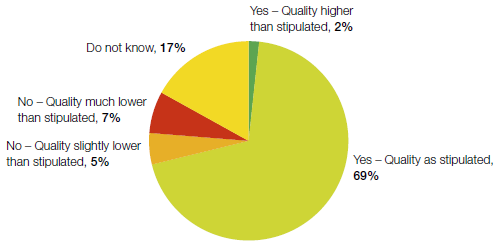
2.9 Failure to monitor asset conditions increases the risk that the public sector receives lower-quality assets and around 55% of respondents recognise they need more knowledge of the assets' condition.20 Just over 70% of respondents expect to receive the assets in the condition stipulated in the contract or higher (Figure 10).21 However, the experience is different for the nine PFI contracts that have already returned to the public sector following expiry - four out of the nine survey respondents were unsatisfied with the condition of the assets they took ownership of.22
2.10 Maintenance carried out by the SPV falls into two categories: reactive maintenance, which is ongoing throughout the contract to ensure the service remains continuously available; or proactive maintenance whereby planned preventative maintenance such as replacing boilers, is carried out at regular intervals. The latter ensures the assets remain fully functional and also that handover conditions are met when the contract ends.
Figure 10 Survey results showing the percentage breakdown of expected asset conditions at contract expiry Seventy-one per cent of respondents expect to receive the assets in the condition stipulated in the contract or better
Note 1 Survey results to question 8: Did or do you expect to receive the asset(s) in the condition stipulated by the Project Agreement? Yes - Quality higher than stipulated - 1, Yes - Quality as stipulated - 41, No - Quality slightly lower than stipulated - 3, No - Quality much lower than stipulated - 4, Do not know - 10. Seventy-one per cent is the share of all 'Yes' responses (42/59=71.19%). Source: National Audit Office private finance initiative expiry survey |
2.11 The SPV will usually build up a dedicated fund, known as a sinking or lifecycle fund, to ensure there is sufficient money to fund the planned maintenance - this was true for more than 55% of the respondents in our survey.23 Every time an authority makes a unitary charge payment, a proportion is set aside specifically to fund future preventative maintenance. The SPV bears the risk of the lifecycle fund being insufficient to meet the replacement obligations, but equally, any surpluses are typically retained by the SPV and paid out to investors.
2.12 This creates an incentive for SPVs to manage the assets efficiently. If assets are well maintained, fewer unplanned replacements are required, leaving a larger surplus in the lifecycle fund at expiry. Equally, there is a perverse incentive to underinvest in assets - some authorities raised concerns that SPVs are 'sweating' the assets and making them last longer than originally planned.
______________________________________________________________________________________
19 The SPV can subsequently pass on maintenance risk to sub-contractors.
20 Question 32b: From your experiences of end of contract management so far, please indicate whether you would have welcomed more or less time, knowledge, capability, resources or guidance in relation to the preparation and negotiation of the contract expiry in regard to knowledge of the condition of asset(s): Number of responses: More - 41, About right - 25, Less - 0, Don't know - 9, 41/75 = 54.67%.
21 Question 8: Did or do you expect to receive the asset(s) in the condition stipulated by the Project Agreement? Number of responses: Yes - Quality higher than stipulated - 1, Yes - Quality as stipulated - 41, No - Quality slightly lower than stipulated - 3, No - quality much lower than stipulated - 4, Don't know - 10, 42/59 = 71.19% from a survey response of 59 (as 16 do not return to the authority).
22 We surveyed 18 expired PFI contracts and received 15 responses. Of those 15 responses, only nine involved assets which transferred to public sector ownership at expiry.
23 Question 13: Did or does the Project Agreement include a provision for a lifecycle fund, sinking fund or other measures to cover maintenance over the life of the contract? Yes - 33, No - 21, Don't know - 5, 33/59 = 55.93%, from a survey response of 59 (as 16 do not return to the authority).