Asset ownership options and future service requirements
3.8 The ownership of assets at expiry will be dictated by the contract. Assets will either fully or partially transfer to the public sector or remain with the private sector. If the assets return to the public sector, authorities have four options: sell the asset if the service is no longer required, tender out the service element to a new private sector provider, operate the service in-house, or do nothing.37 Situations which require continuity of service, with the assets reverting to public sector ownership, represent the greatest risk to government. Our survey highlights that this group represents the largest share of the outstanding contracts (Figure 12 on page 37).
3.9 In some instances, the future ownership of assets and responsibility for administering the PFI contract are not aligned. Schools which have converted to academy status are outside of the remit of the authority and are run by independent academy trusts. These trusts are funded directly by the Department for Education (DfE). The responsibility for administering the PFI contract, however, remains with the authority until it ends. The authority may not be incentivised to use its resources to manage the expiry process effectively knowing that they will not retain ownership of the assets. According to DfE, around 300+ schools with PFI contracts have been converted to academy status.
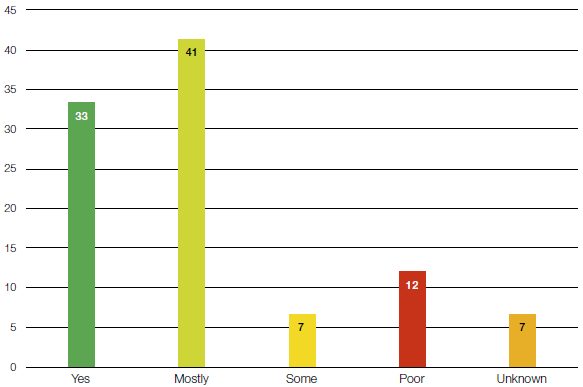
| Figure 11 Percentage breakdown of survey respondents' views on whether private finance initiative (PFI) contracts clearly define the roles and responsibilities at expiry Only one-third of respondents stated that the roles and obligations of different parties at expiry are clearly defined Percentage
Note 1 Survey results to question 10: Were or are the role and duties of the parties at contract expiry defined clearly enough in the Project Agreement so that there is no misunderstanding by the parties involved? Yes - the Project Agreement clearly defines all parties roles and obligations at contract expiry - 25, Mostly - most roles and obligations are well defined - 31, Some - some roles and obligations are well defined, but others are not - 5, Poor - the roles and obligations of parties are poorly defined - 9, We have not reviewed the Project Agreement in sufficient detail to be able to respond to this question - 5. Source: National Audit Office private finance initiative expiry survey |
3.10 The authority will need to assess whether the service provided under the PFI contract, such as operating a waste disposal plant, will be required once it has expired. The requirement for the service depends on many different factors, such as changes in demand, technology or wider government policy. For example, in one accommodation-type PFI contract, the authority decided not to enter into a new lease post-expiry. Existing publicly owned offices were to be used instead, following the authority's estate rationalisation programme.
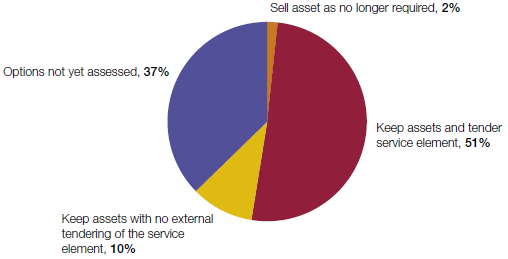
| Figure 12 Survey results showing the percentage breakdown of expected treatment of assets and services post-private finance initiative (PFI) contract expiry More than 50% of respondents stated that at expiry the assets will be kept by the authority with the service being tendered out to a private sector provider
Note 1 Survey results to question 5: What happened or does the authority currently expect to happen to the transferred asset(s) and the related services after the contract expiry? Sell asset as no longer required - 1, Keep assets and tender service element - 30, Keep assets with no external tendering of the service element - 6, Options not yet assessed - 22. Source: National Audit Office private finance initiative expiry survey |
3.11 Once the nature of the future service is established, the authority will need to decide how this will be delivered post-expiry. Options include running the service in-house using existing public sector resources, procuring a service delivery contract with a new private sector provider or extending the existing PFI contract. The breadth of options may depend on the resources and skills available to the authority. A government department or large authority may be able to absorb expiring PFI contracts into existing operations, but this may not be a viable option for smaller authorities.
3.12 The PFI contract itself may restrict how the service could be delivered in the future. We identified an example whereby the PFI contract stipulates that a payment of £1 million be made to the SPV should the authority decide to enter into a service delivery contract with a new provider upon expiry. This reduces the competitiveness of a tender process and may result in the authority having to extend the contract or enter into a new agreement with the existing SPV. In another example, Transport for London (TfL) started to engage with the SPV two years prior to expiry following the timeframe set out in the contract. Owing to the complex nature of the project, however, it required at least three years to fully assess and implement the future service delivery option. As a result, TfL negotiated a short-term contract with the incumbent delivery partner.
3.13 The authority will need to consider the resource requirements of maintaining assets after they take over management at the end of the contract. This is particularly important for authorities that have been receiving PFI grants, as this additional source of funding will expire when the contracts end.38 Where PFI assets are not returned in the stipulated condition and subsequently require more than expected maintenance work, the authority's maintenance backlogs across its entire estate will increase. We have previously reported that less funding is available to address maintenance backlogs - in 2015-16 and 2016-17, HM Treasury allowed the NHS to move more than £1 billion of funding allocated for capital investment to pay for day-to-day spending.39
3.14 In just over 20% of the contracts in our survey responses, the public sector will not take over ownership of the assets at expiry.40 In these cases, the authority will still need to assess its need for the assets post-expiry. If so, it may need to purchase or find alternative assets either through procuring, leasing or building new ones. This can represent a considerable cost and may take years to resolve. For example, in one accommodation-type PFI contract, the homes did not transfer to the authority on expiry. Owing to the location and lack of alternative housing, the authority had to purchase the homes at market value, running into tens of millions of pounds.
______________________________________________________________________________________
37 The 'do nothing' approach could involve the asset being moth-balled or re-provisioned elsewhere within an authority's existing operations.
38 PFI grants provided central government funding to local authorities to deliver PFI projects.
39 Comptroller and Auditor General, HM Treasury, PFI and PF2, Session 2017-2019, HC 718, National Audit Office, January 2018, para 1.12, p.10.
40 Question 4: On contract expiry, did or will the asset(s) (school, hospital, road, etc) transfer to the authority? Number of responses: Yes - 49, Partially - 10, No - 16, 16/75 = 21.33%.