Disputes
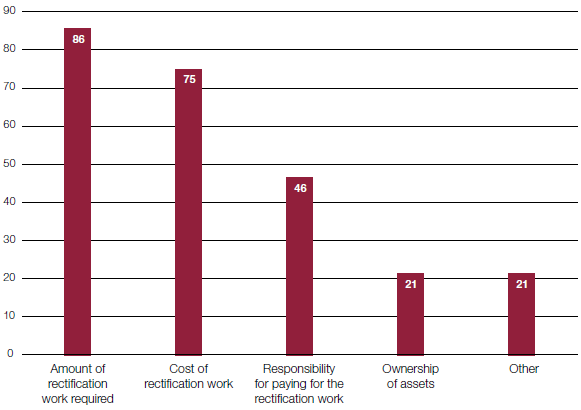
3.26 If any contractual ambiguity cannot be resolved via negotiations with the SPV, the remaining option is to go through the formal disputes process. Each PFI contract will set out a formal procedure for handling disputes, called the Dispute Resolution Procedure (DRP). More than one-third of respondents expect to have formal disputes with the SPV regarding the handover of assets.52 Around 86% of anticipated disputes relate to the amount of rectification work needed, while 75% relate to the cost of any rectification work (Figure 16 overleaf).53,54 Of the 15 expired contracts in our survey, two went through DRP. One dispute related to the cost of purchasing assets at expiry, while the second related to the quality of the maintenance being carried out by the SPV. A survey carried out by the authority found that the maintenance work was carried out by unqualified people. One dispute remains in the courts awaiting appeal while the other was resolved by extending the contract on terms which required remedial action by the SPV.
Figure 16 Survey responses on reasons for anticipated private finance initiative (PFI) contract expiry disputes The amount and cost of rectification work required are stated as the most common reasons for disputes Percentage
Reasons for anticipated dispute Notes 1 Survey results to question 15a: What did or do you expect the disputes to relate to? Please tick all that apply: Amount of rectification work required - 24, Cost of rectification work - 21, Responsibility for paying for the rectification work - 13, Ownership of assets - 6, Other - 6. Only those who responded to question 15 (Has there been or does the authority expect there to be, any formal disputes between the authority and the contractors regarding the handover of assets?) with 'Yes', of which there were 28, were asked this question. 2 The 'other' category includes potential issues such as the performance of the assets, sinking fund arrangements, termination payments and intellectual property rights. 3 Data does not sum to 100% as the survey question contained multiple choice responses. Source: National Audit Office private finance initiative expiry survey |
3.27 DRPs can be lengthy despite aiming to be more efficient and cost-effective than going to arbitration or through the courts. In one contract we reviewed, the DRP could take a minimum of 10 months to complete. Some contract managers have also raised concerns that the DRP is expensive, which may prohibit authorities from pursuing this option, especially given that a positive outcome is not guaranteed. In the case of an unsuccessful DRP, resolving disputes via arbitration and the courts can increase costs even further. Authorities need to balance the benefits and costs of such an approach, including whether additional financial support is available.
3.28 HE has developed an informal issue resolution procedure designed to settle disagreements before they are escalated to a formal dispute. This represents a quicker and more cost-efficient process should issues be resolved without a DRP. The procedure involves both HE and the SPV nominating individuals who have the authority to engage in discussions and reach an agreement. Stage one takes place at the operational level in order to discuss the technical issues of the dispute. If an agreement is not reached, the issue is escalated up the management chain, with stage two review being carried out at a project manager level. Failure to reach an agreement after stage two results in the contractual DRP being the next option.
______________________________________________________________________________________
52 Question 15: Has there been or does the authority expect there to be, any formal disputes between the authority and the contractors regarding the handover of assets? Number of responses: Yes - 28, No - 47, 28/75 = 37.33%.
53 Question 15a: What did or do you expect the disputes to relate to? Please tick all that apply: i. amount of rectification work required, ii. cost of rectification work, iii. responsibility for paying for the rectification work, iv. Ownership of assets, v. other. Number of responses: 24/28 = 85.71% mentioned the amount of rectification work as a source of dispute. From a survey response of 28 (as only 28 replied yes to Question 15 - see footnote 52 above).
54 Question 15a as footnote 53: 21/28 = 75% mentioned the cost of any rectification work as a source of dispute.