1.2 Survey Reports
On the basis that all three building surveying practices were appointed on a similar scope of service, the reports issued by the respective consultants were broadly similar in terms of findings and recommendations albeit in some cases, their reports were structured differently.
Generally, all three building surveying practices' reports followed a similar structure with reports setting out the following information: -
1. Executive Summary
2. Introduction
3. Background
4. General Description
5. Client Supplied Information
6. Handback Conditions
7. Survey Methodology
8. Building Condition Summary
9. Life Cycle Maintenance Assessment and Analysis
10. Fire Precautions and Means of Escape
11. Summary of Health and Safety Condition
12. Conclusion and Recommendations
13. Appendices including drawings and photographs
Largely, the surveys comprised of an inspection of the various facilities within the sites which were then collated and reported on a site-wide basis, together with comment on site-wide elements i.e. hard landscaping, fabric and M&E etc. The inspections were undertaken over a prescribed period of days as defined within the relevant tenderer's responses with all final reports subject to audit and peer review to ensure that the information presented was robust, subject to the constraints of the survey, including as to sampling, access and limitations on the level of intrusion.
The outputs of the condition surveys were used to demonstrate the order of costs that are expected to be incurred by ProjectCo up to the end of contract, together with those that are expected to exist in the period of the following five years after the end of contract to enable the relevant Authorities to understand the potential financial exposure.
All buildings within the surveys were the subject of a visual non-disruptive inspection and the surveyors reported on their findings utilising condition indicators and priority ratings set out in the scope of service. Protocols were utilised to provide a more accurate assessment of priorities with weightings applied to identify those issues with Health and Safety implications; statutory compliance implications; and those which may have a greater effect on the operation of the premises.
The surveys have identified and prioritised the buildings/structures/assets most at risk and those which are vulnerable to risk (both in terms of condition and life expectancy) including associated costs.
Indicative costs were applied to identify the level of expenditure required to maintain or bring assets up to the acceptable standard i.e. condition B or better. The indicative costs were based on rates published by the Building Cost Information Service of the Royal Institution of Chartered Surveyors and the Chartered Institution of Building Services Engineers, and other recognised pricing mechanisms modified as necessary by the consultants based on their experience of undertaking similar exercises.
The snapshot below with an end of contract date of 2025 summarises the assessment of condition, anticipated asset life, remaining asset life, comments, remedial action and associated cost for replacement.

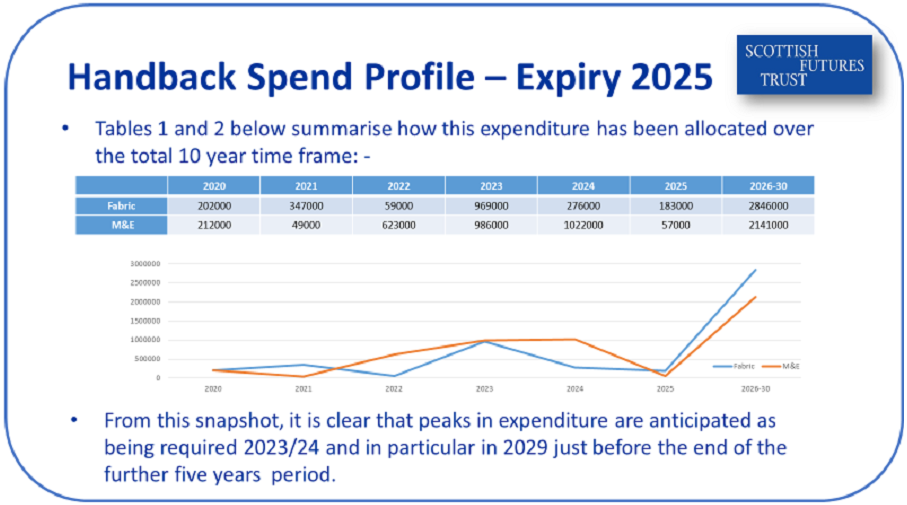
Typically, the reports then went on to identify anticipated expenditure levels required over the remaining years of operations up to the contract expiry date to bring the assets within the facilities up to an acceptable standard and/or to maintain them at that standard i.e. condition category B or better.
In addition, the reports identified further potential costs that may be incurred during the post-handback period of a further five years i.e. the first five years post the end of contract date.
From the snapshot below with an end of contract date of 2025, it is clear from this example that peaks in expenditure are anticipated as being required in 2023/24 and in 2029.
The reports have enabled all participating Authorities to have a detailed understanding of the level of investment that is needed to provide a safe working environment in well maintained buildings that are fit for purpose, this should provide a basis for ongoing discussion with ProjectCo in terms of its anticipated spend profiles for the remaining life of the contract. The reports also highlighted all actions necessary to address the failings identified with indicative costs provided to give Authorities an indication of the expenditure levels required over the remaining years in order that the Facility is handed over in a condition compliant with the Handover requirement.