OVERVIEW
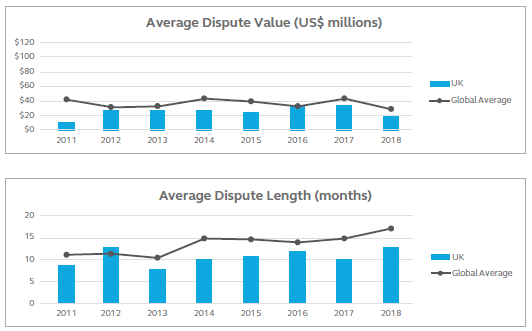
The average value of construction disputes in the UK decreased by 47% to $17.9 million during 2018, continuing to demonstrate the UK remains under the global average. This is a significant decrease compared to the average values of the previous six years, particularly given the continuing impacts of Carillion's liquidation and the Grenfell Tower tragedy. It is only the second time our findings experienced an average dispute value below $20 million.
During 2018, the average length of time taken to resolve disputes in the UK has increased to almost 13 months, up approximately 28% from 2017. This is consistent with the global trend experienced for 2018 which highlighted that disputes are taking longer on average to resolve. Positively, the UK remains the jurisdiction with the shortest average length of time to resolve a dispute.
The method of party-to-party negotiation re-emerged as the most commonly used dispute resolution method. Mediation continues to rank third in the UK. As we predicted in last year's report, our survey respondents have seen a reduction in the use of adjudication (contract or ad hoc) in the UK to resolve disputes during 2018.
We suggest this may be an impact of the confirmation received in the Court of Appeal decision in S&T (UK) Ltd v Grove Developments Ltd [2018] EWCA Civ 2448, reducing the use of 'Smash 'n' Grab' adjudications. It could also stem from dissatisfaction with the ever-escalating cost of the adjudication process and a tendency for significant extensions to the prescribed 28-day statutory period for a decision.
The UK continues to experience most disputes being resolved after they have crystallized; rather than parties seeking to avoid or mitigate a potential dispute situation. While it is extremely encouraging that parties are using negotiation as the preferred method to resolve their disputes; it appears these are occurring at a stage in the dispute cycle when the most effort, cost and time are typically required.
In terms of the most important factor in the mitigation or early resolution of disputes, contract mandated early resolution formats (DAB's/mediations) did not appear highly in our survey results. Our respondents determined the number one factor as a willingness to compromise in the dispute would lead to mitigation or early resolution of the dispute. This appears to suggest that enforced implementation of early forms of dispute resolution is simply not enough and a focus on party conduct or attitudes could help to improve early avoidance or mitigation of disputes.
| DISPUTE VALUE (US$ MILLIONS) | LENGTH OF DISPUTE (MONTHS) | |||||||||||||||
| 2011 | 2012 | 2013 | 2014 | 2015 | 2016 | 2017 | 2018 | 2011 | 2012 | 2013 | 2014 | 2015 | 2016 | 2017 | 2018 | |
| United Kingdom | 10.5 | 27 | 27.9 | 27 | 25 | 34 | 34 | 17.9 | 8.7 | 12.9 | 7.9 | 10 | 10.7 | 12 | 10 | 12.8 |
| 2018 RANK | DISPUTE CAUSE | 2017 RANK |
| 1 | A failure to properly administer the contract | 1 |
| 2 | Employer/Contractor/Subcontractor failing to understand and/or comply with its contractual obligations | 2 |
| 3 | Failure to serve the appropriate notice under the contract | 3 |
| 2018 RANK | MOST COMMON METHODS OF ALTERNATIVE DISPUTE RESOLUTION | 2017 RANK |
| 1 | Party-to-party negotiation | 2 |
| 2 | Adjudication (contract or ad hoc) | 1 |
| 3 | Mediation | 3 |