DISPUTE CAUSES
During 2019 a failure to make interim awards on extensions of time and compensation became the top ranked common cause of disputes within the United Kingdom industry. While this replaces a failure to properly administer the contract (the previous five years' top cause), it continues a trend of the top dispute cause relating to those administering contracts.
Repeating 2018's findings, over 75% of respondents continued to report Project Manager (PM) or Engineer's conduct was always or very often at the heart of how the dispute crystallized. The most common cause when the PM or Engineer's conduct was at the heart of a dispute crystallizing was a lack of understanding of the procedural aspects of the contract.
It is therefore unsurprising that over 60% of respondents stated that proper contract administration would have the single largest impact in avoiding disputes in which they were involved. It appears there may still be lessons to be learned for those administrating contracts.
The second ranked common dispute cause continues to be contractor/subcontractor failing to understand and/or comply with its contractual obligation. This suggests that contract obligations ostensibly drafted in plain English (such as the NEC forms) are not as easily understood by practitioners as the lawyers drafting them. Perhaps it is time for greater representation of true practitioners on the contract drafting bodies to ensure that those administering contracts fully understand the consequences of their actions/inactions.
The key focus from the survey responses relates to those administering the contracts, however, the second cause suggests contract obligations are drafted in a manner which makes it difficult for all parties to follow. Greater use of more collaborative standard forms of contracts, i.e. PPC 2000, TPC 2005 and FAC-1, might provide more confidence in project delivery. However, this can only really be driven by the owners and their representatives. Little appetite has been shown for these types of contracts, bearing in mind that it is now almost 20 years since the PPC/TPC forms were first introduced.
Positively, over half of respondents stated the cost of resolution compared to value of outcome was the most important factor when considering whether a dispute was successful or not. We hope next year's survey will show these views influenced the dispute resolution methods deployed and we will see an increase in usage of party-to- party negotiation, mediation, and other forms of early dispute resolution.
2019 RANK | MOST COMMON DISPUTE CAUSES | 2018 RANK |
1 | Failure to make interim awards on extensions of time and compensation | New ranking in 2019 |
2 | Contractor/Subcontractor failing to understand and/or comply with its contractual obligations | 2 |
3 | Poorly drafted or incomplete and unsubstantiated claims | New ranking in 2019 |
2019 RANK | MOST COMMON METHODS OF ALTERNATIVE DISPUTE RESOLUTION | 2018 RANK |
1 | Adjudication (contractor or ad hoc) | 2 |
2 | Party-to-party negotiation | 1 |
3 | Arbitration | New ranking in 2019 |
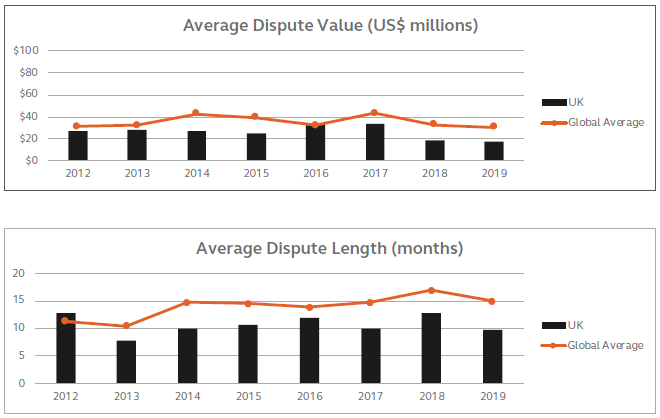
| DISPUTE VALUE (US$ MILLIONS) | LENGTH OF DISPUTE (MONTHS) | ||||||||||||||
2012 | 2013 | 2014 | 2015 | 2016 | 2017 | 2018 | 2019 | 2012 | 2013 | 2014 | 2015 | 2016 | 2017 | 2018 | 2019 | |
United Kingdom | 27 | 27.9 | 27 | 25 | 34 | 34 | 17.9 | 17.8 | 12.9 | 7.9 | 10 | 10.7 | 12 | 10 | 12.8 | 9.8 |