Chapter 1: Introduction
1.1 The Green Book is guidance issued by HM Treasury on how to appraise policies, programmes and projects. It also provides guidance on the design and use of monitoring and evaluation before, during and after implementation.
1.2 The Green Book should be used alongside other HM Treasury guidance:
 Managing Public Money which provides guidance on the responsible use of public resources
the Aqua Book which sets out standards for analytical modelling and assurance
the Magenta Book which provides detailed guidance on evaluation methods
1.3 Green Book guidance applies to all proposals that concern public spending, taxation, changes to regulations, and changes to the use of existing public assets and resources - see Box 1 below.
Box 1. Scope of Green Book Guidance
| Green Book guidance covers:
|

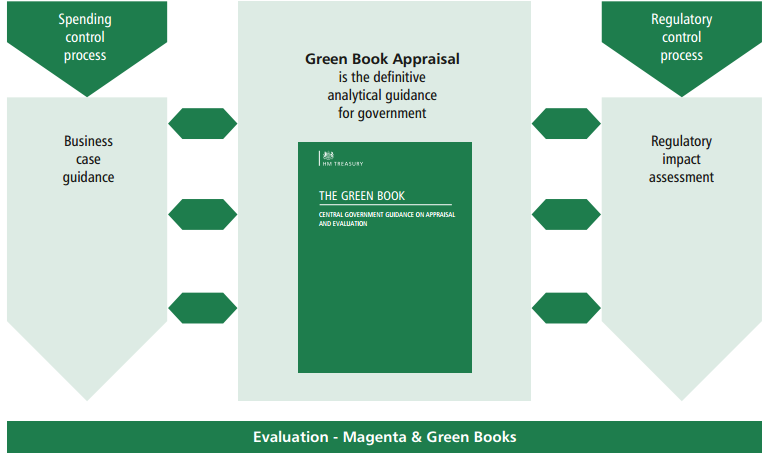
1.4 The role of appraisal and evaluation is to provide objective analysis to support decision making. Decision making processes include the scrutiny of business cases by government departments, Treasury Approval Processes and the Regulatory Impact Assessment process. The principles of the Green Book should also support options appraisal when formal decision making processes are not required. The relationship between Green Book guidance and government decision making processes is shown in Figure 1.
1.5 The Green Book is not a mechanical decision making device. Rather, it provides approved guidance and methods, recommended tools for developing options and standard values for use across government. It helps officials develop transparent, objective and evidence-based advice for decision making that is consistent across government.
1.6 This guidance should be applied proportionately. The resources and effort employed should be related to the scale of the proposals under consideration.
1.7 Monitoring and evaluation of all proposals should be planned, costed and provided for as an integral part of a proposed intervention under consideration.
Figure 1. The Green Book and Appraisal in Context
1.8 This guidance has been designed to be accessible to a variety of users - from policy officials to analysts. Accordingly, it follows a tiered structure where:
a high-level overview is provided in chapters 1 - 3
detailed information for practitioners is provided in chapters 4 - 8
technical information and shared valuations for use in appraisal are provided in annexes 1 - 6
hyperlinks have been inserted to allow users to cross-reference within the Green Book and associated supplementary guidance
1.9 The Green Book's chapters are as follows:
chapter 2 provides a non-technical introduction to appraisal and evaluation
chapter 3 provides an overview of how appraisal fits within government decision making processes
chapter 4 explains how to generate options and undertake long-list appraisal
chapter 5 explains how to undertake detailed Social Cost Benefit Analysis of a short-list of options
chapter 6 sets out the approach to valuation of costs and benefits
chapter 7 sets out how to present appraisal results
chapter 8 sets out the approach to monitoring and evaluation
annexes 1 - 6 provide further technical information and values for use in appraisal across government