Assessing and valuing effects on the natural environment
6.45 Natural capital includes certain stocks of the elements of nature that have value to society, such as forests, fisheries, rivers, biodiversity, land and minerals. Natural capital includes both the living and non-living aspects of ecosystems.
6.46 Stocks of natural capital provide flows of environmental or 'ecosystem' services over time. These services, often in combination with other forms of capital (human, produced and social) produce a wide range of benefits. These include use values that involve interaction with the resource and which can have a market value (e.g. minerals, timber, fresh water) or non-market value (e.g. outdoor recreation, landscape amenity). They also include non-use values, such as the value people place on the existence of particular habitats or species. Where service flows are not marketed, or market prices do not include their full value to society, non-market values may be estimated using the range of non-market valuation techniques or tools.
6.47 Understanding natural capital provides a framework for improved appraisal of a range of environmental effects alongside potentially harmful externalities such as air pollution, noise, waste and GHGs.
6.48 Natural capital stock levels should be systematically measured and monitored for the social costs and benefits of their use to be understood and controlled (see report to the Natural Capital Committee). A focus solely on the marginal valuation of a loss in services may overlook the potential for large reductions in stocks. This could then lead to dramatic reductions in present or future services. Similarly, the cumulative effects of multiple decisions on natural capital stocks need to be considered. Where appropriate therefore, and particularly for major impacts, assessments should consider whether affected natural assets are being used sustainably.
Figure 3. The Natural Capital Framework
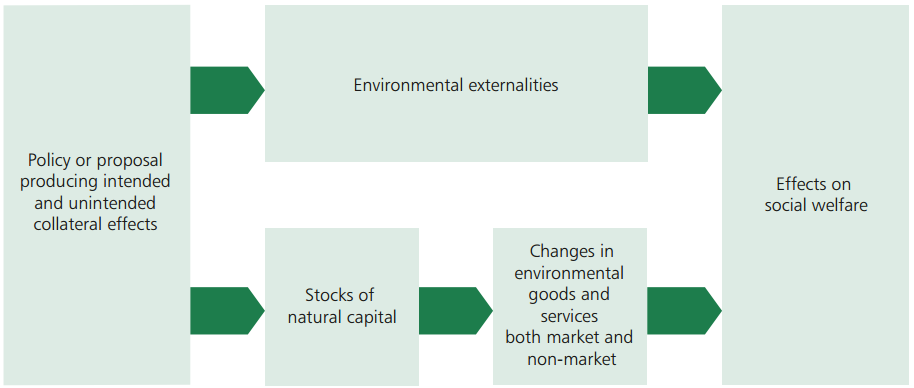
6.49 Figure 3 shows the natural capital framework. This does not replace existing approaches to appraising and valuing environmental effects. Rather, by providing a more comprehensive framework within which to develop and appraise policy, it suggests additional options to meet policy goals and enables all options to be assessed more accurately for potential improvements and/or damage to the environment.
6.50 As a first step, the following questions can be used to consider the impact on natural capital. Is the option likely to affect, directly or indirectly:
 the use or management of land, or landscape?
the atmosphere, including air quality, GHG emissions, noise levels or tranquillity?
an inland, coastal or marine water body?18
wildlife and/or wild vegetation, which are indicators of biodiversity?19
the supply of natural raw materials, renewable and non-renewable, or the natural environment from which they are extracted?
opportunities for recreation in the natural environment, including in urban areas?
6.51 If the answer to one or more of these questions is "yes" or "maybe", further assessment is recommended as outlined in Annex 2.
_________________________________________________________________________________
18 The water cycle cuts across natural assets, and includes non-tidal rivers, lakes, ponds, wetlands, floodplains as well as groundwater, coastal estuaries, the marine environment.
19 Wildlife can be affected by direct changes to protected sites and by disrupting or creating connections between sites.