Measuring and valuing risks to longevity
A2.48 For Social Cost Benefit Analysis involving risks to longevity, clarity is required concerning how length of life is affected by the risk or intervention. Longevity can be measured as life expectancy. This can be expressed as the area under a survival curve, which shows the likelihood of surviving to any given age, as illustrated in Figure 6. Life expectancy is a statistical expectation of the risk of dying at any given age, rather than a specific number of years. If for example a cohort of 100,000 people faced a 1% risk of dying aged 30 to 40, and an intervention could eliminate this risk, the intervention could be described as preventing 1,000 fatalities.
A2.49 The black line in Figure 6 represents the survival profile without the intervention and the green line with elimination of all 1,000 deaths between the ages of 30 and 40. The cohort collectively would live an extra 45,000 statistical life-years (SLYs), compared with Business As Usual. The cohort's life expectancy would increase by 0.45 years per person; and the unknown 1,000 people whose early deaths are prevented would each gain, on average, 45 years of life expectancy. They are not certain to live an extra 45 years, this is their average statistical expectation of life. This valuation method does not relate to "life-or-death" circumstances affecting specific individuals. It is unknown which members of the cohort would be the prevented fatalities.
Figure 6. Illustration of longevity effects
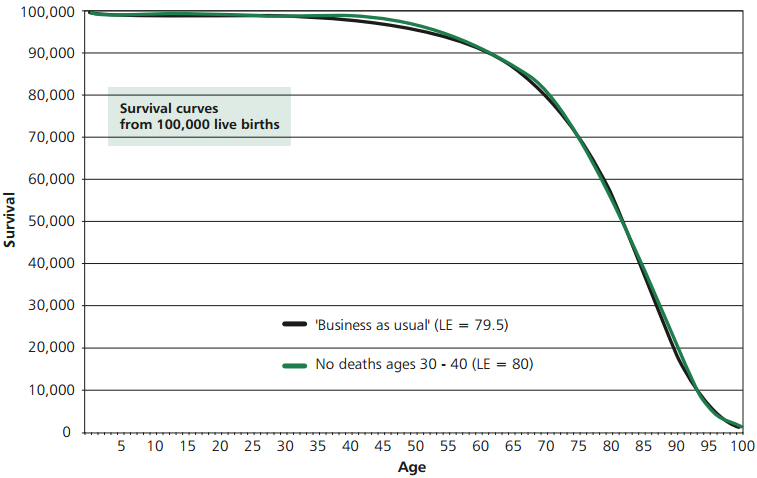
Source: Illustrative analysis provided by the Department of Health and Social Care
A2.50 Monetary valuations of a VPF have been used in transport appraisals for several decades. They derive from research conducted on behalf of DfT. The current value and references to the research on which it is based can be found on the DFT webpages.
A2.51 The value of a SLY is derived from the same empirical evidence as a VPF. SLYs help with the appraisal of options where the number of years of life expectancy at risk differs between options; valuing impacts in terms of SLYs offers a way of allowing for this difference. The current monetary value for a SLY is £60,000 and is updated annually (see DFT web pages for further information).