EXECUTIVE SUMMARY
The G20 IWG Survey on PPP Development underlying this Report provides reference on the frameworks for infrastructure financing through Public-Private Partnership in G20 economies, by focusing on systems of infrastructure policy governance (Chapter 1), legal approaches to PPP implementation (Chapter 2), mechanisms facilitating return on private investments in PPPs (Chapter 3), fiscal and other supportive measures, as well as green infrastructure provisions (Chapters 4 and 5) and digitalization trends in infrastructure policy (Chapter 6). The Report aims to provide a better understanding of the countries' strategies and approaches to PPP implementation and facilitate peer-to-peer learning. Examples of possible measures for policy-making are proposed for consideration on a voluntary basis by G20 countries as relevant in view of country-specific conditions and national priorities. In addition to countries' input, this Report also makes use of other public sources, including research by International Financial Institutions (IFI) and relevant line agencies' websites.
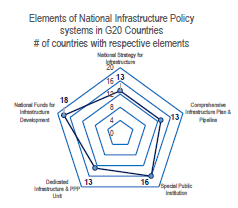
| The Survey shows that G20 countries have quite a diverse infrastructure policy systems. Half of the responding countries have special national strategies and plans for infrastructure, as well as specific public institutions and PPP units. 18 countries have set up national infrastructure funds. According to the Survey, a general trend in G20 countries is the provisioning of a sound and consistent multiannual infrastructure agenda, as well as building the relevant institutional capacity. |
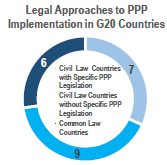
| The G20 respondents fall into 3 groups depending on the legal approaches to PPP implementation. The majority of countries are of a civil law family with 7 countries having specific PPP legislation and 9 countries without it. 6 countries belong to common-law countries where there is no specific PPP legislation, yet PPP-related guidelines and recommendations may be in place. Responses to the G20 Survey show that countries tend to preserve the distinctive character of PPP regulation, which takes account of country-specific legal and policy practices, as well as often choose to have parallel regulation for both concessions and PPP agreements. |
| All surveyed countries reported the use of availability payments and user-pays models as mechanisms to facilitate return on private investments in PPP projects. Several countries reported to use the Minimum Revenue Guarantee mechanism to share demand-side risks between parties to a PPP project. Countries' experience shows increased attention to implement systems and tools for comprehensive demand risk assessment and the evaluation of financing models' efficacy. |
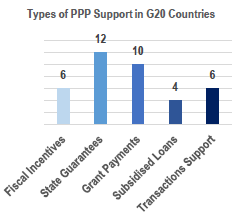
| The Survey shows that G20 countries use various measures to support the PPP market. Half of the respondents provide state guarantees and grant payments. One-third of countries incentivise PPPs with fiscal instruments. Several countries also provide subsidised loans and support private partners in property transactions. G20 countries pay attention to the elimination of duplicative and incoherent supportive measures applied in a specific policy mix. Management of contingent liabilities in PPPs and fiscal monitoring are as well on the prospective policy agenda. |
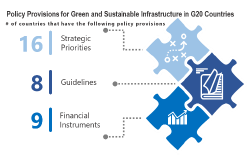
| Many G20 countries have introduced policy provisions related to green infrastructure. According to the Survey, 16 countries have included such provisions into official strategic documents. 8 countries have elaborated green infrastructure guidelines, whereas 9 countries implement green infrastructure projects using a range of innovative financial instruments. As the development and financing of quality infrastructure require the participation of a range of public and private investors, it may be crucial to embed environmental and social assessment of infrastructure projects in a country's policy mix. |
| Digitalisation is a cross-cutting issue for all spheres of the economy and society, including infrastructure. To date, several international databases on infrastructure and PPP exist, which have been developed by the World Bank, the Global Q Infrastructure Hub, IJ Global and the Sustainable Infrastructure Foundation. They accumulate practice and evidence from multiple countries. National infrastructure databases and platforms also exist. As shown by the G20 Survey, 7 countries use infrastructure project databases, and several have introduced comprehensive infrastructure platforms. It may be crucial to explore the potential of digitalisation to support closing global infrastructure data gaps while effectively managing data security issues. |