How complex is your contract?
The following terms are used in this guide to describe contracts based on the level of complexity, the risk profile and the value. These terms are intended as a guide only - each entity will have its own context and operational environment that will inform its approach to assessing and categorising risk.
In this guide we use the following terms to categorise contracts:
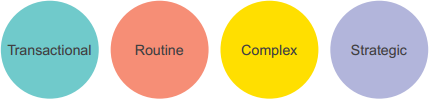
Determining the appropriate level of contract management required for your contract allows you to focus your attention on the key activities within the management of your contract, in a way that is proportional to the risk profile of your contract.
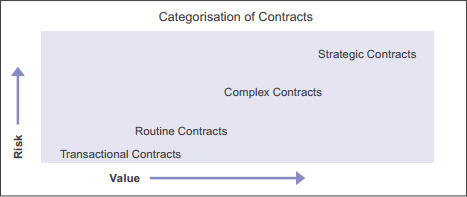
The table below identifies the characteristics or qualities of each type of contract. You should assess which category your contract aligns with. These qualities are only indicators that your contract may fall into a certain category. Your contract does not have to meet all the characteristics and may meet characteristics from more than one category. You will need to use judgement as to whether your contract fits into one category or another. If you are deciding between two categories, go with the categorisation with the higher risk level.
The tables at the beginning of the sections for each contract management phase will assist you in identifying which activities are appropriate based on this categorisation.
Table 1- Categorisation of contracts
The characteristics below are only indicators of each type of category. You will need to assess which category aligns more closely with your contract
Qualities | Transactional | Routine | Complex | Strategic |
Key Defining Factors | The goods or services are: • generally low value • readily commercially available, off the shelf • able to be readily sourced from numerous suppliers • do not require any special handling, modification or adaptation. | The goods or services are: • generally below the procurement threshold or may be above the threshold for large quantities or long term purchases • readily commercially available • able to be sourced from numerous suppliers • do not require any special handling, modification or adaptation. | The goods or services are: • generally valued above the procurement threshold • commercially available • able to be sourced from a number suppliers • will most likely have a statement of work or complex specification • may require some special handling, modification or adaptation. | The goods or services are: • generally high value and high complexity but some lower value procurements may be strategic for reasons other than price • sourced via a complex open tender or staged sourcing approach • available from a limited number of suppliers in the market • may need to be created or developed specifically for the procuring entity or require extensive modification or adaptation if commercially available • will have an involved statement of work or complex specifications. |
Risk Profile | Very low risk. Formal risk assessment not required. | Generally low risk. May need to identify and analyse risks. Consider current controls and if any additional actions are required. Findings and actions will need to be documented. | May present medium risks. Will need a formalised risk assessment or managment plan that will require: - identification - analysis (likelihood / consequence) - evaluation (controls and prioritisation) - treatments - documentation of findings and actions. | May present high risks. Will need a formalised risk management plan that will require: - identification - analysis (likelihood / consequence) - evaluation (controls and prioritisation) - treatments - documentation of findings and actions. Risks will need to be actively managed. |
Delivery | Usually transactional contracts will involve a single delivery to one location. | It may involve a single delivery of higher cost items or deliveries to a number of sites over longer periods. | Delivery will most likely be phased over a number of milestone events over longer periods. Formalised acceptance procedures may be required. | Delivery will most likely be phased over a number of milestone events over longer periods. Acceptance will be based on formalised procedures within the contract. |
Payment | Payment will often be made by credit card, or on invoice immediately after the delivery and acceptance of the goods or services. | Payment is usually made in arrears on invoice after the delivery and acceptance of the goods or services and total costs may be progressively paid over time as deliveries are received. | Payment arrangements may be more complex, and will generally include partial payments, milestone payments or other staged payment approaches. These contracts may also contain a reduction in payment for under performance. | Payment arrangements are usually complex and will include staged payment, milestone payment and/or earned value payment approaches. These contracts may also contain incentive payments or reduction in payment for under performance. |
Performance Monitoring | Performance monitoring is based on common sense checking that the goods or services were as ordered and correctly received. | Performance monitoring is usually based on common sense checking, supported by processes such as spot audits, acceptance checks and referring to the contract to be sure that the goods or services were as specified and correctly received. | Performance monitoring is usually formalised, and may involve progress reports from the supplier, progress and performance meetings with the supplier and may draw on performance indicators or service level agreements in the contract. | Performance monitoring is formalised, and usually involves progress reports from the supplier, progress and performance meetings with the supplier, and draws on performance indicators or service level agreements in the contract. |
Timeframe | Short term. | These contracts usually extend for short periods, typically between a few days up to a couple of months but may also involve larger quantities of off-the-shelf goods or services over longer periods. | These contracts typically extend for anywhere from a few months to several years. | These contracts are generally longer term and may run for several years. |
Contracting Vehicle | Use purchase order, email or verbal acceptance of quote. | Use purchase order, CCS contract or may be sourced from a panel. | CCS contract, purpose-built contract or may be sourced from a panel. For ICT requirements, the digital sourcing contract templates (from DTA) may be appropriate. | Purpose built bespoke contract or entity specific template. For ICT requirements, the digital sourcing contract templates (from DTA) may be appropriate. |
Organisational Impact | These goods or services are not critical to the operation of the entity, which could operate reasonably without them. | These goods or services are not usually critical to the operation of the entity, which could operate for a reasonable period without them. There may be some inconvenience if the goods or services are delayed. | These goods or services are usually important, but not critical, to the operation of the entity or may be important in managing risks facing the entity. There would be some impact on the way the entity operates if the goods or services were delayed, and there could be considerable inconvenience, but this would not usually prevent the achievement of major entity goals. | These goods or services are vital to the achievement of major entity goals and may be significant for managing risks or seizing opportunities. There would be significant, noticeable and unacceptable impact on the way the entity operates if the goods or services were delayed. |
Examples of how contracts may be categorised are below:
• Catering for a meeting or workshop would generally be transactional, however, catering for a large public event may be complex.
• Labour hire would generally be routine, however, if you have complicated security and access requirements then this may increase the level of categorisation.
• A contract for office furniture would generally be routine, however, if this is part of an office fit-out then it may be complex.
• The customisation and integration of a software system would generally be a complex contract, however, if the contract is for the development and implementation of large entity specific software applications then this may be strategic.
If you are unsure about how to categorise your contract, then contact your central procurement area for assistance.