|
|

| The right delivery model approach enables clients and industry to work together to deliver the best possible outcomes by determining the optimal split of roles and responsibilities. |
| Driving better, faster, greener delivery |
|
| • Considering the delivery model alongside the desired outcomes and the value profile will better enable organisations to define roles and responsibilities that best protect value and enable delivery of those outcomes. • Actively assessing the most appropriate delivery model (rather than adopting familiar but potentially inappropriate models) will enable transformational change. | |

The delivery model assessment (DMA) is an analytical, evidence-based approach to reach a recommendation on how a contracting authority should structure the delivery of a project or programme. It is a strategic decision that should be given consideration with an appropriate level of analysis and attention applied. This should take place early enough to inform the first business case stage (Strategic Outline Case for departments and ALBs).
To determine which delivery model offers the best value, an analysis of the value profile, strategic risks, client and market factors is required and should inform the split of roles and responsibilities across the client and market.
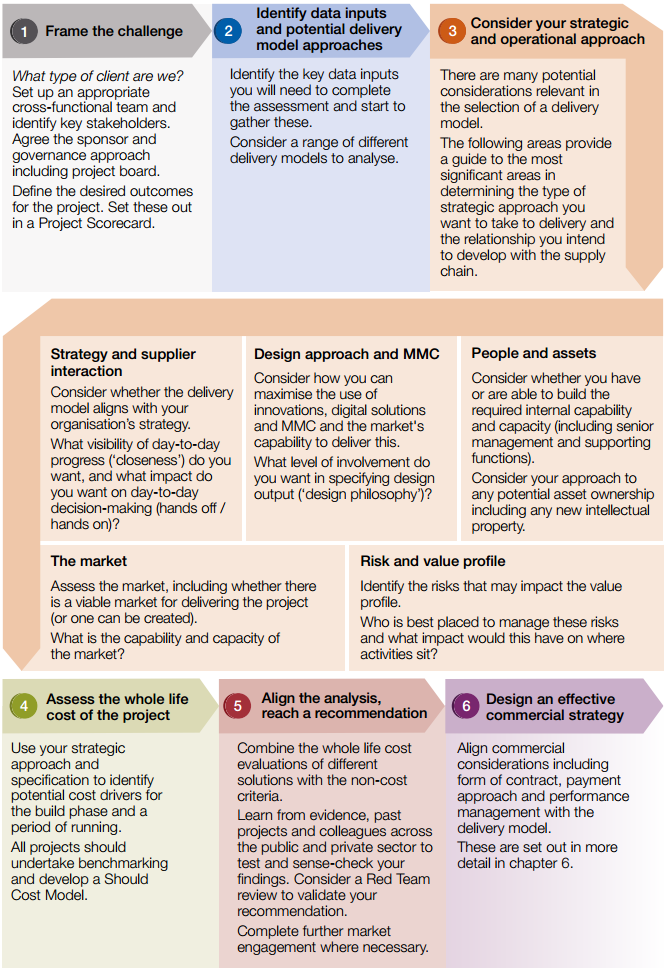
The structured approach, set out in Figure 2, provides a high-level framework consistent with the options appraisal approach prescribed in the Green Book. Contracting authorities should consider a wide range of potential delivery models and how each model would support a value-based approach across the whole lifecycle. HM Treasury and the IPA now apply additional scrutiny of projects and programmes to ensure that the chosen delivery model best delivers the project and programme objectives.
The key is to start by thinking about the objectives and outcomes you want to achieve (Step 1), your strategic approach (Step 3), and a robust understanding of whole life costs (Step 4) before deciding on an appropriate commercial approach to operationalise the delivery model (Step 6). Once we understand our strategic approach to the delivery model, we need to reflect that in our commercial approach - the way we procure, contractualise and manage works (see chapter 6).
Figure 2. Delivery model assessment for public works projects and programmes.
Potential delivery model approaches
| Strategic approach | Common features |
| 1: Transactional "I know my requirement, who can best deliver it?" | Traditional approach in which the industry is engaged to provide a standard service, with competition at procurement. |
| 2: Hands-on leadership "Given the complexity I'll need to watch over this closely." | Complexity of work and stakeholder environment in which the client needs greater control. Certainty of outcome and stakeholder management are more important than lowest cost. |
| 3: Product mindset "I need lots of these and need them to get better, greener and faster." | Learning the lessons of repeatability from manufacturing, often with extensive use of digital design and Design for Manufacture and Assembly. Should lead to progressive improvement and efficiency. Viability depends on a visible pipeline of repeatable products. |
| 4: Hands-off design "I need to solve this problem, and I am willing to allow significant flexibility as to the solution." | The client is clear on the outcome and agnostic as to the solution (which may not even require a physical structure). Open to innovation and amenable to using technology to solve the problem instead. |
| 5: Trusted helper "I need help, come and perform for me without me having to tell you how that needs to be done." | The client is focused on its core business and requires competent suppliers (often in a safety critical environment) that may know the client's operating procedures or technical challenges better than the client. There is close proximity between client and market, and workloads may fluctuate. |