Social PPPs
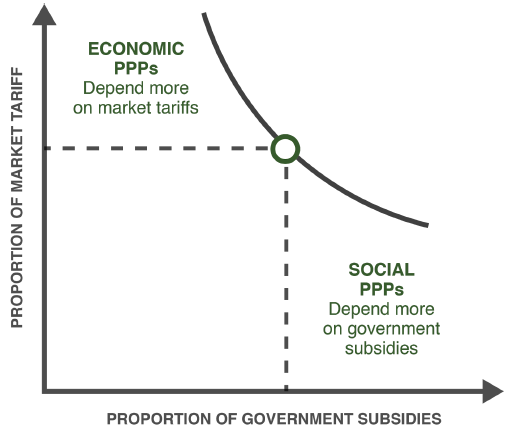
Social PPPs are those that require significant (more than 50% of operating revenue) government subsidies-such as healthcare or water systems. These types of PPPs are trickier to manage in low- and middle-income countries because the financial costs of running them substantially exceed their realistic market prices. In many cases, the poor may be regular users, but cannot afford to pay a market price for services without substantial government support. In middle-class countries, subsidies may be lower. Social PPPs, being inherently dependent on subsidies, are considered far riskier for investors because they are long-term assets dependent on short-term political cycles to renew subsidies. Therefore, social PPPs require greater skill, a more adaptable project structure, and more flexible financial models. However, with proper structures and alignment of interests-using the frameworks, evidence-based case studies, and skills-risk can be reduced, and a social PPP can still return value to all partners. This value may be financial, but in the case of social PPPs, it may also take a number of different forms, such as social good, public goodwill, or improved worker productivity. (We will discuss value as a concept in detail in Section Three.)
Generally speaking, healthcare PPPs tend to fall on the social side of the spectrum. In low-and middle-income countries, until populations stabilize, healthcare costs can run high. For most consumers in these countries, the market price is out of reach. However, that doesn't mean that healthcare PPPs cannot be viable. With well-structured incentives, a social PPP can still yield operating returns over the long-run. (Operating returns can be profits, but they can also be strategic objectives, market entry objectives, or brand image improvements.) But bringing the private sector along for a social PPP is more complicated. It requires a deeper understanding of what motivates the private sector to enter a given market.
___________________________________________________________________________________________________
17Trager, Guan, & Rai, "Mapping PPPs"