Different Kinds of PPPs Face Unique Challenges
While there are many ways to form a PPP, most projects will involve the use of a Special Purpose Vehicle (SPV). A special purpose vehicle is a legal entity formed to separate the PPP from either the public- or private-sector partner.
SPVs offer several distinct advantages for PPP projects. First, an SPV affords a project its own, siloed structure for decision-making and governance. Rather than attempting to coordinate decisions and approvals across large government ministries or corporate structures, partners can empower the SPV to make decisions quickly, efficiently, and independently. An SPV can also help to shield partners from risk, by creating a distinct legal entity from the partners to act as the PPP itself. The SPV can also insulate the partnership from risk, ensuring that a PPP's obligations are unaffected by financial turbulence among one or both of the partners.
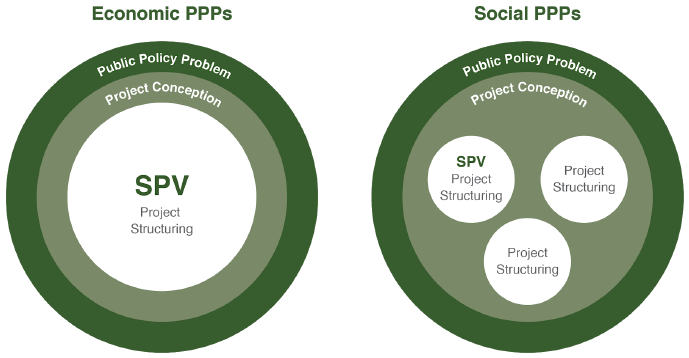
But while SPVs are commonplace in PPP structuring, the way that a project is structured can vary widely between economic and social PPPs. Let's examine the visualization on the opposite page. In this diagram, the relative area of each concentric circle corresponds-roughly, of course-to the degree of difficulty presented by each element of the PPP process. It's easy to see that economic and social PPPs present distinct challenges. As we can see, economic PPPs tend to be more straightforward. Once the problem is understood, most resources going towards solving the problem are contained in the structuring of a single project. Compare this to the diagram of a social PPP, in which project conception requires considerably more work, and often results in structuring multiple transactions, and thus multiple SPVs. Large-scale social PPP projects can actually result in many distinct SPVs, all within a single project. This is due to the fact that-without the clear promise of monetary returns to the private sector-social PPPs tend to be more delicate, and often require discrete, interconnected solutions to several distinct issues.
For social PPPs, a large percentage of a project's difficulty lies in identifying the exact contours of a public-policy problem and conceiving of the project itself. Without the promise of adequate returns to motivate the private sector, even the preliminary step of developing an appealing project becomes a daunting task-though not an impossible one. There are ways of minimizing risk and maximizing opportunity, as we will discuss shortly.