Internalizing Positive Externalities
In capitalist systems, governments are generally expected to take on the less profitable functions of civil society. Publicly owned and controlled assets such as mass transit systems, water systems, or sanitation systems-while they are crucial to maintaining a functioning society-generally cost more to operate than the revenue they bring in. These costly liabilities can prove debilitating to a government's balance sheet. However, these assets all contain potentially positive externalities. Mass transit systems reduce traffic and auto exhaust on city streets, and water and sanitation systems enable citizens to live healthy, productive lives.
If a PPP could take that untapped economic value and internalize it into the economic equation, then these costly liabilities might become less costly. In fact, if these externalities could be properly internalized, then these liabilities might not even be liabilities at all; they might be assets in disguise. By acknowledging and unlocking the untapped value that these assets provide-the act of internalizing positive externalities-PPPs can create a more accurate economic equation that correctly values these assets. We can see how liabilities become assets by returning once more to the parks of New York.
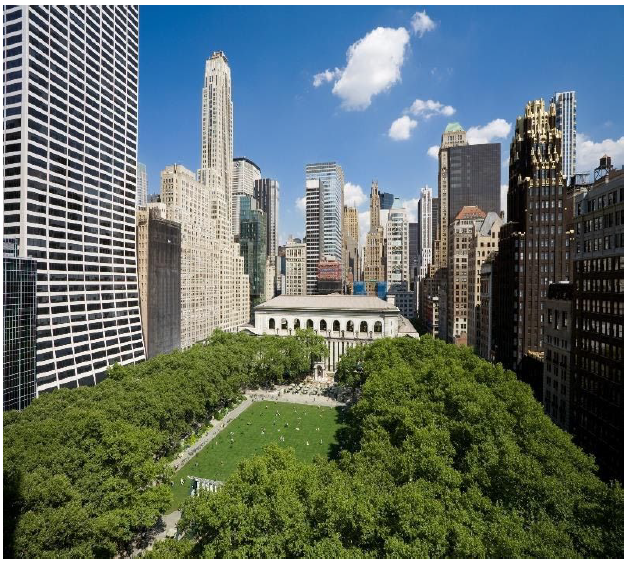
CASE STUDY Parks and Partnerships: Bryant Park31
Though today it is a beautiful asset to its community, Manhattan's Bryant Park was once a costly liability for the New York City Parks Department. Much like Central Park, Bryant Park was poorly maintained, a haven for crime, and an eyesore to the neighborhood. The Bryant Park Restoration Corporation was established in 1980 as a not-for-profit private management company charged with renovating and managing Bryant Park. By turning over restoration of the park to the private sector, the Parks Department felt it could offload a costly liability without sacrificing the quality of the park. For their part, realizing the value that a beautiful park could provide to its neighbors and surrounding businesses, the Corporation decided to source capital, both human and financial, by internalizing the park's potential externalities. Following a rigorous stakeholder analysis (a skill we will discuss in further detail in just a few pages), the Corporation came up with a set of potential stakeholders who had a vested interest in seeing the park improve, a list that mainly included the park's corporate neighbors and surrounding businesses. Eventually, the analysis led the Corporation, in conjunction with the city government, to form a Business Improvement District (BID). While there are dozens of BIDs in New York City, Bryant Park's is the only one established explicitly for a park. The BID amounts to what is essentially a "voluntary tax" paid by property owners surrounding the park, the proceeds of which must be invested in the park's upkeep. Though the project of revitalizing the park using private money took seven years to complete, it was ultimately a massive success. Bryant Park now stands as an anchor between Grand Central Terminal and Times Square, and as any one of the park's 12 million annual visitors can attest, the neighborhood around it has been transformed. The PPP faced issues, of course. There were accounting issues-how to develop a special "lockbox" account for the exclusive use of the BID? There were budgetary issues-how would the BID define the kinds of activities that were counted in the park's budget, and how could the PPP design a five-year budget that would suit the project? There were policy issues-the park's success needed to be available on a long enough timeframe to account for its ultimate success or failure, but it also needed to be converted from a pilot project to a fully-scaled operation effectively. And of course, there were messaging issues-there were those who felt the park had been privatized, and that it had become discriminatory. How could the PPP's value be effectively communicated to the public? We will discuss how government professionals can address these kinds of challenges later in the guide, but despite these smaller hurdles, the BID's design had already succeeded on a structural level. By devising a structure that enabled the internalization of a small portion of the positive externalities of the park, such as increases in real estate values, tourism, health, and happiness, the NYC Parks Department was able to take a public liability-an unsafe, dirty park-and turn it into a highly profitable public asset. And, by participating in the BID, private-sector entities around the park were able to contribute to higher real estate values and tourism revenues, which in turn produced substantial new taxable value to the city government. Key Skills and Frameworks • Engaging the Public as a Partner • Social PPPs vs. Economic PPPs • Turning Liabilities into Assets • Innovation • Political Management/Governance |
___________________________________________________________________________________________________
31John D. Donahue. (2004). Parks and Partnership in New York City. Harvard Kennedy School 1743.0.