Key Skill: Innovation
PPPs, in addition to being financing tools, can also be powerful drivers of innovation. Innovation can come in many forms. As we've discussed, creative financing can unlock hidden value, and creative operational innovations can create economies of scale where they did not exist before. But more importantly, innovations in PPP are driven by the frameworks underpinning successful PPPs. Governments can provide and support an environment for innovation.
Ultimately, the frameworks and models that underpin PPPs are just as flexible as the PPPs themselves. "PPP thinking" doesn't necessarily mean picking from a list of applicable solutions or grafting the lessons of a certain case study onto a situation. By internalizing the concepts and frameworks that underpin successful PPPs, successful practitioners can develop new, innovative solutions to seemingly intractable problems.
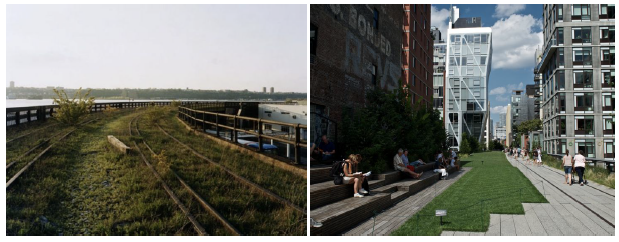
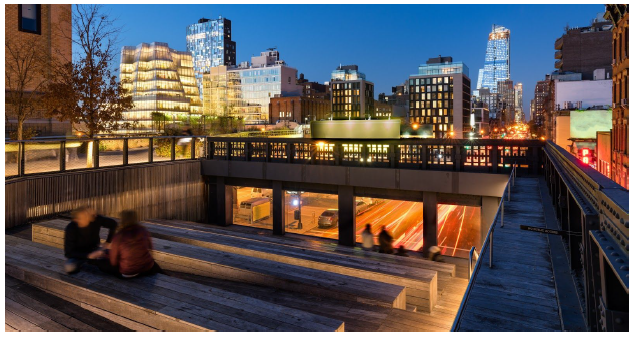
EXAMPLE The High Line40 If we examine these two pictures, we can see how innovation in a public-private partnership can transform entire neighborhoods at a net profit to the city government. This first picture shows the New York Central Railroad's West Side Line, an elevated structure cutting its way through West Chelsea in Manhattan. No longer used for freight traffic, the hulking steel structure was a useless eyesore, casting its dark shadow over the entire neighborhood.
Movements to tear down the structure cropped up several times in the latter half of the 20th century, but it wasn't until 1999 that two Chelsea residents came up with the idea of turning the unused elevated tracks into a public park. They established Friends of the High Line and set to pitching their case to the city. They argued that, unlike demolition, their plan could actually net the city money by creating a valuable new public asset. Says John Alschuler, chairman of real estate consultancy HR&A Advisors, a firm to whom Friends of the High Line turned for assistance, "Our firm did a very rigorous, very careful study and we argued, absolutely correctly, as it turned out, to the government, that an investment in park and open space will return more cash value back to the government in terms of increased property tax revenue, increased sales tax revenue, increased income tax revenue, that would pay three, four times what the cost of the park was." In 2002, a more PPP-friendly administration assumed control of the city government (under the leadership of New York's new mayor, Michael Bloomberg, and new parks commissioner, Adrian Benepe) and prospects for the High Line improved significantly. In 2005, the city created a Special District, much like Bryant Park's BID, rezoned to allow for mixed residential and commercial use. And the Special District came with an added incentive. Property owners near the High Line would be allowed to build higher than typical zoning allowed. Developers quickly took advantage of the opportunity to build higher, and the city used the additional money to finance stairways and elevators that would allow future visitors to access the viaduct. In 2006, after a series of design competitions, construction on the High Line began. Using an innovative authorizing structure involving five different institutions-Friends of the High Line, the city's Economic Development Corporation, the Department of City Planning, the Parks Department, and the mayor's office-the High Line was able to fast-track approval processes. Of course, there were trade-offs. Having so many institutions involved also created numerous redundancies and inefficiencies. In 2009, the city and Friends of the High Line signed a public-private agreement stipulating that while the park would be incorporated into the city parks system, the city would maintain the viaduct holding up the park, and Friends of the High Line would operate and manage the park itself. "The first two sections of the park cost $152.3 million, of which the city provided $112.2 million, the federal government $20 million and New York State $400,000. The park's annual operating budget averaged around $3 million a year. In 2011, Friends of the High Line brought in about $30 million and spent about $20 million, much of that for construction. Construction of the third and final section began in 2012 and was projected to cost $90 million, toward which the city committed $10 million." By 2013, the city's analysis put the cumulative economic benefit of the park at close to a billion dollars, well over the roughly $200 million HR&A had originally projected."41 Today, if you visit the High Line, you'll see a beautiful park-one of the most popular in New York City. But of course, if you look to either side of the old rail bridge, you'll also notice other important changes-an array of boutique hotels, high-priced apartments, and revenue-generating retail shops and restaurants.
In the end, Alschuler was right. The increased tax revenue brought in by the High Line paid for the park many times over. By 2013, the city's analysis put the cumulative economic benefit of the park at close to one billion dollars. By combining the authority of the public sector to enact change with the ability of the private sector to raise capital, a PPP structure was able to transform not just a rail bridge, but an entire neighborhood in the process. As of 2018, the park-a mere seven acres-saw about eight million visitors each year.42 The High Line proves the ability of PPPs to imagine new, innovative solutions: turning liabilities into assets, sharing risks, opportunities, and governance, and internalizing positive externalities. |
___________________________________________________________________________________________________
40Bowen, T., & Stepan, A, "Public-Private Partnerships for Green Space in NYC, " Columbia University School of International and Public Affairs, 2014, Case Number 14-0005.0.
41Bowen & Stepan, "Public-Private Partnerships for Green Space."
42C.J. Hughes, "The High Line: A Place to See and Be Seen." The New York Times, December 12, 2018.