Conflicts of Interest: The Limits of Voluntary Partnerships
We have discussed how, despite many governments' staunch prohibitions against conflicts of interest in private-sector engagement, conflicts can often be managed effectively. Of course, this is not always the case. In many situations, private-sector actors can be unable (or unwilling) to move their business models into adequate alignment. These cases often require a "firmer touch," meaning more aggressive governance. But, there are still ways to be strategic and tactical about assigning disincentives to misaligned industries, without necessarily employing taxation (which, while sometimes necessary, can be a greater political challenge). For its part, the private sector must also recognize that, to a certain extent, the costs imposed by large industries that are misaligned with NCD goals are so great as to make aggressive government action inevitable. We have seen this in the tobacco industry, and this aggressive approach may soon become more common with soft drinks and processed foods.
The case of the Health Promotion Board offers a potential roadmap for addressing unresolvable conflicts, using economic thinking to positively impact NCD outcomes without resorting to taxes.
CASE STUDY Singapore's Health Promotion Board
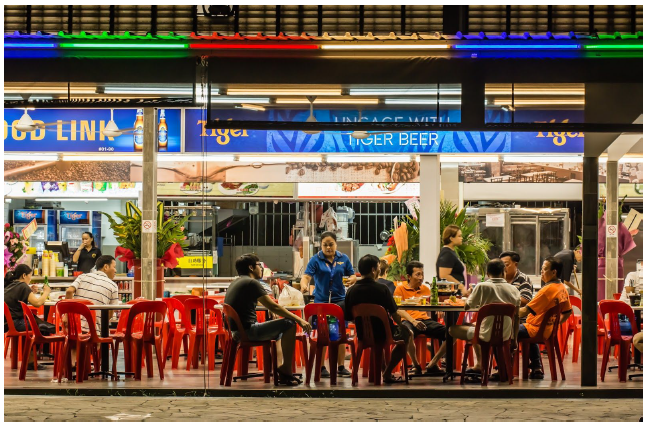
While HPB's use of the Healthier Choice Symbol (HCS) decal offers a positive incentive for hawkers willing to adjust their recipes, there are situations in which tougher tactics are required. Private-sector companies are often unable or unwilling to bring their business model into further alignment with public-sector health goals. In these cases, powerful conflicts of interest necessitate powerful disincentives. Singapore's Ministry of Health (MOH) recently announced a new program to reduce sugars and saturated fats in pre-packaged beverages. Cooperating with the HPB (and building on their successful HCS program), the MOH recently announced plans to assign a letter grade-A, B, C, or D-to all pre-packaged beverages, depending on its relative nutritional value. Grades will be determined by examining sugar and saturated-fat content. The system, dubbed "Nutrigrade," assigns powerful disincentives to beverages assigned poor grades. Unhealthier beverages (those graded C or D) will be required to print their grade on packaging, and beverages assigned a D grade will be banned from advertising online, in print, and anywhere else except at point-of-sale. In fact, the Nutrigrade grading system is not too dissimilar from this Guide's concept of Value Alignment. Each of the four categories corresponds-roughly of course-to one of the modes of Value Alignment, A-graded producers being in perfect alignment, B being imperfect, C being potential, and D being misaligned. But where the HCS program offered incentives for well-aligned hawkers and food producers, the Nutrigrade system uses governmental authority to push misaligned producers towards better alignment. While the HCS program will continue, its standards will be aligned with Nutrigrade such that all HCS-eligible beverages must receive either an A or a B grade. This adaptation and evolution of the HCS program demonstrates its efficacy, but also the need for significant disincentives to motivate companies that are unable or unwilling to align their interests with the public good. These packaging requirements and advertising prohibitions will strongly push misaligned beverage companies towards better alignment. In other words, if the HCS program was a carrot, Nutrigrade adds a potent stick. |