Chapter Eight Team Work on Site
8.1 The work of the Review has not been only about disputes between main contractors and specialist/trade (sub) contractors76. It is, however, those which have generated most heat and correspondence. Some main contractors have said that they have no real problems, and that relations with subcontractors are generally good. Doubtless that is the case with some firms and some sites. If it were always so, my post bag would have been much lighter, and the Review much quicker. But it is not always so.
8.2 The most persuasive evidence in this regard was-provided for me by a national contracting firm. The company commissioned a survey in August 1993 from an independent survey team77. The survey questioned a sample of subcontractors, representative of most major trades, size, volume of work with the company, and geographic region. It included a small number of subcontractors who were reluctant to bid for work with the company, or had failed to win work recently, All those questioned were aware that the company had commissioned the survey. The questions included the most controversial issues between main contractors and subcontractors, such as:
1. Are your tenders dealt with fairly?
2. Does the company indulge in Dutch Auctions or similar practices?
3. How comfortable are you with the main contractor's terms and conditions? (The company has its own subcontract form.)
4. Are you fairly treated on financial matters?
5. Are contra-charges handled properly?
6. Do you feel part of the team?
8.3 The interviewees were asked to score each of the answers against a prescribed 1 to 10 rating system. 7 was "acceptable", 6 "fair", 5 "poor". Below 5 was "very unsatisfactory", 8 was "better than acceptable, good" and 9 "very good". Most importantly, benchmarking was undertaken against other main contractors. The results showed:-
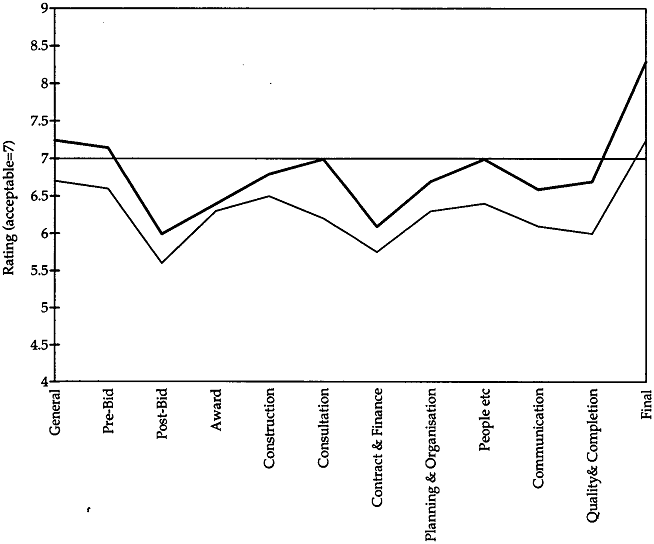
1. Only on the answers to the final questions - such as the overall reputation of the company and hoping to work with them again - did it rate better than acceptable, good (8.3).
2. Its ratings on post bid as a whole were below acceptable (6.0) as was the answer regarding dutch auctioning (5.8).
3. Most interviewees were very uncomfortable with the company's terms and conditions (5.2), with contra-charging particularly criticised (4.8).
4. The overall mean rating of company across all sections of the survey was below acceptable(6.8).
5. The company did better than its combined competitors (6.5). Table 13 compares the results, with the company being the bold line and the combined competitors the other line.
TABLE 13: THE COMPANY VERSUS ITS COMBINED COMPETITORS: TREATMENT OF SPECIALISTS
8.4 The survey conclusions were:
1. "If [we are] truly to become an excellent company the appraisal of our performance by specialist contractors is a key indicator. In almost all areas the company is seen to perform below an "acceptable" level."
2. "It is an industry problem. Where we are better, so are our competitors. Where we score poorly, so do others. Inherently the industry "macho" culture, where we reward crisis management and "screw the subbie", is at fault."
3. "This attitude does not motivate specialist contractors to perform at their highest levels."
4. "The performance of specialist subcontractors is crucial to the success of our organisation. If we can improve the quality of support we give to specialists, then the quality of product and service will be measurably superior. .. It will also reduce conflict."
8.5 The report (written by a senior University lecturer) went on to recommend that the company should:
1. Develop better relations through partnering or partnership arrangements.
2. Involve subcontractors earlier to achieve project objectives, and develop greater team involvement through the project life cycle and beyond.
3. Utilise the skill and knowledge of the subcontractors more fully and better, and recognise that subcontractors can and want to make a greater contribution.
4. Develop a more structured, standardised and ethical approach to the procurement and management of subcontractors.
________________________________________________________________________________________________________________________________
(Source: survey for the company on the level of satisfaction of specialist contractors in dealing with it, both main report and executive summary, 1993)
| 8.6 That report and its conclusions speak for themselves. The intention behind the survey was commendable and is part of a drive by that company to improve its own performance for clients. It indicates a real and progressive attempt to examine that company's relationship with its subcontractors and how this might be improved. Such feedback provides a valuable resource and other firms should carry out similar surveys. Further detailed work, including survey results carried out amongst specialist/trade contractors in the Autumn of 1992, will be set out in the report of a project for CIRIA currently being finalised by the Centre for Strategic Studies in Construction, University of Reading, assisted by Sir Alexander Gibb & Partners Limited.78 |
8.7 The problems of this contentious area were set out in the Interim Report. The commercial realities are well known. Teamwork cannot be achieved unless all sections of the process are committed to it. That must include:-
1. Clients, who vary in their interest. Some, including some Government Departments, display no discernible interest in subcontractors. Other clients take an intense interest in all participants on and off site, for the reasons set out above. Some clients go to considerable lengths to brief subcontractors and their operatives on-site to ensure that they feel fully part of the construction team.
2. Consultants, on whatever basis they are retained and under whatever procurement route, especially as they often seek to transfer responsibility for detailed design to specialists.
3. Main contractors, whose role in pulling together the performance of the contract is crucial. Some evidence has argued that main contractors no longer have a necessary role in the modern construction industry or even that their influence is malign. I do not agree. They remain the most effective mobilisers and co-ordinators of resources. They are responsible for the smooth running of the whole site throughout its operation, and for the performance and quality of the work of all their domestic subcontractors.
4. Specialist/trade contractors, many of whom (particularly specialists) also employ sub subcontractors. Some of the smallest subcontractors, including those at the very end of the construction process such as landscape companies or those responsible for road lining, have a particular sense of grievance at their treatment. Some smaller specialist engineering contractors complained, both directly and through the Confederation of Construction Specialists, about the onerous contract conditions which they received from larger engineering specialists to whom they were in subcontract relationship.
8.8 I have already described the necessary action in other vital areas:-
1. The client deciding upon the project and contract strategy, and an effective brief being prepared.
2. Implementing the desired procurement route, and choosing the team to do so, including fair methods of remunerating them and ensuring effective performance.
3. Following responsible qualification and tendering procedures, drawing upon registered contractors and subcontractors.
4. Appropriate contract conditions, based on teamwork and "win-win" principles.
___________________________________________________________________
76 Even the terminology is a matter of dispute! The JCT, ICE and GC/Works/1 Standard Forms use the expression ''subcontractor". The SEACC system uses ''specialist contractor". Specialists who are involved in design work tend to differentiate between themselves and "trade contractors" who are not.
77 The identity of the company, and the people who carried out the survey, must remain anonymous. The company also undertook a separate survey in Scotland. The results were similar, though more favourable. The company's mean rating was 7.2, the average of the 7 competitors considered was 6.9. The score of 7 was "acceptable".
78 "Guide to Effective Specialist and Trade Contracting" by Gray, Hughes and Murdoch, currently unpublished report for CIRIA.