5.1.1 Conduct an immediate stocktake
What has changed is the scale of the transport infrastructure construction agenda, and the advent of the pandemic-induced recession. These two factors make more urgent the need to review and potentially re-prioritise projects. The International Monetary Fund argues that such a review and re-prioritisation should include revisiting benefit cost analyses in light of the social changes caused by the COVID-19 crisis. It also argues for a well-coordinated system for actively monitoring projects, differentiated by project size, complexity, and stage.133
Recommendation 1 The Auditor-General of each state, and where relevant, the Commonwealth, should conduct an immediate stocktake of the transport infrastructure projects in progress, and for each one valued at $100 million or more report on: • the announced cost at close of contract • the expected total cost and the reason for any change from the announced cost • the announced date at close of contract of coming into operation • the expected date of coming into operation, and the reason for any change from the announced date • the announced scope at close of contract • any changes to scope and the reasons. |
Figure 5.1: Most large projects are still committed to without an approved business case
Proportion of projects costing more than $500m, committed to in 2017-2020, with business case published or assessed by a relevant infrastructure body
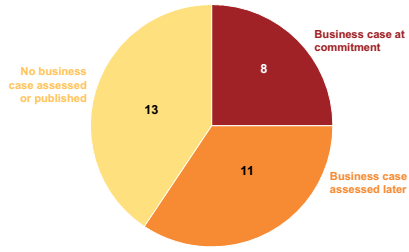
Notes: Includes all fixed infrastructure projects with expected total cost greater than $500 million, committed to since December 2016. Does not include budget items referring to a program of smaller works. 'Committed' here refers to a budget allocation being made for construction of the project in a state or territory budget, or the Commonwealth budget in the case of Inland Rail.
Source: Grattan analysis.
____________________________________________________________________________
133. IMF (2020, p. 35).